





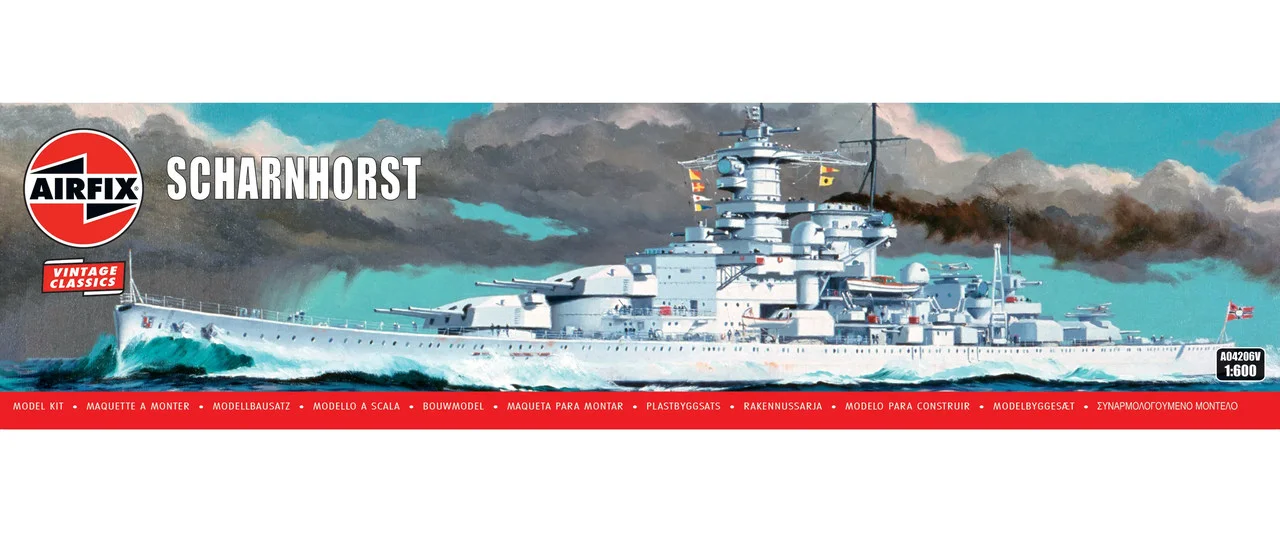
Airfix 04206V - 1:600 Scharnhorst - Airfix Vintage Classics
Do darmowej dostawy brakuje Ci jedynie 299 zł
Masz darmową dostawę ✓
Product code: AIRF-04206V
Barcode: 5063129053901
Ask about the product

Administratorem danych osobowych jest Sklep Modelarski Exito. Przetwarzamy je w celu przesłania odpowiedzi na zapytanie. Więcej informacji dotyczących przetwarzania danych osobowych znajduje się w polityce prywatności.
Share the product card



Leave feedback on the product

Description
German warship Scharnhorst plastic model kit in 1:600 scale
Airfix 04206V is a construction kit representing the German warship Scharnhorst — a vessel whose classification is still debated by historians, since she combined the speed and armament of a battlecruiser with battleship-grade armour protection. The kit comes from classic Airfix tooling and has been reissued in the Vintage Classics series, in which the brand returns titles from its historic catalogue to the range.
The model comprises 159 parts and measures close to 385 mm when complete. The ship's distinctive silhouette is captured: three main turrets with 28 cm guns, secondary armament in turrets and casemates, the substantial forward superstructure with rangefinders, and the raked, capped funnel. 1:600 is the classic Airfix naval scale, allowing a collection of major surface units to be built in consistent proportions.
What's in the box:
- Injection-moulded plastic sprues — 159 parts in total
- Decal sheet
- Painting guide sheet
- Illustrated assembly instructions
Specifications:
- Scale: 1:600
- Catalogue number: 04206V
- Manufacturer: Airfix
- Series: Vintage Classics
- Finished model length: approx. 385 mm
- Model beam: approx. 50 mm
- Part count: 159
- Skill level: beginner/intermediate
Please note: this kit does not include glue, paints or modelling tools. The model is intended for self-assembly.
Building the model:
The kit follows the layout typical of classic Airfix warship models: a hull assembled from major sub-components, a separate deck, and a set of superstructure and armament parts fitted towards the end of the build. The hull seam and the deck fit deserve the most attention — careful dry-fitting and clean-up of these joints has the greatest effect on the finished model. Small anti-aircraft guns and deck fittings are easier to paint while still attached to the sprues, cleaning up the attachment points only just before fitting them in place.
Wartime Kriegsmarine vessels are typically finished in greys: a lighter tone on the superstructure and upper hull with a darker shade along the waterline, wooden decks in greyish brown tones and steel decks in dark grey. The exact scheme is given in the manufacturer's instructions. With such large hull surfaces an airbrush is worth considering, with details picked out using a wash applied into recesses and along superstructure edges. The model displays well both on a dedicated display base and in a simple seascape diorama.
Tools you will need:
- Modelling sprue cutters
- Hobby knife or scalpel
- Files and sanding paper for cleaning up sprue gate marks
- Polystyrene cement (e.g. Tamiya Extra Thin Cement)
- Modelling putty for filling the hull seam
- Precision modelling tweezers for small parts
- Brushes in a range of sizes
- Model paints (acrylic or enamel)
- A modelling wash to emphasise deck and superstructure detail
- Matt varnish for the final coat
About the ship – Scharnhorst:
Scharnhorst was the first of two large gun-armed warships built by the Kriegsmarine in the second half of the 1930s. She was launched in 1936 and commissioned in January 1939. The design was a compromise between treaty limitations and German naval ambitions: nine 28 cm guns in three turrets — a smaller calibre than contemporary Allied battleships carried — combined with very heavy armour and a speed of over 31 knots. Her classification varies in the literature, where she is described both as a battleship and as a battlecruiser.
Scharnhorst made her name as a commerce raider. In 1940, together with her sister ship, she took part in operations against shipping in Norwegian waters, sinking the aircraft carrier HMS Glorious among others. In early 1941, during Operation Berlin, the two ships spent two months in the Atlantic, sinking or capturing more than twenty merchant vessels. In February 1942 Scharnhorst took part in the celebrated Channel Dash from Brest to German ports.
Her final sortie came in December 1943, when she left the Norwegian fjords to attack an Arctic convoy. On 26 December, in polar darkness and appalling weather, Scharnhorst was intercepted by a British force led by the battleship HMS Duke of York. Crippled by gunfire and finished off by torpedoes from cruisers and destroyers, she sank that same evening north of the North Cape. Of the nearly two thousand men aboard, only 36 were rescued. The Battle of the North Cape went down in history as the last engagement between major gun-armed warships in European waters.
Original ship specifications (Scharnhorst):
- Standard displacement: approx. 32,100 long tons
- Full load displacement: approx. 38,100 long tons
- Overall length: 234.9 m
- Beam: 30 m
- Draught: 8.3 m (standard) / 9.9 m (full load)
- Propulsion: 12 water-tube boilers and 3 steam turbine sets, 3 shafts, approx. 151,900 shp
- Maximum speed: approx. 31.5 knots
- Range: approx. 7,100 nautical miles at 19 knots
- Crew: approx. 1,670
- Main armament: nine 28 cm SK C/34 guns in three turrets
- Secondary armament: twelve 15 cm SK C/28 guns
- Anti-aircraft armament: fourteen 10.5 cm guns, sixteen 3.7 cm guns and 2 cm cannon
- Torpedo armament: six 53.3 cm tubes
- Armour: belt up to 320 mm, turrets 200–360 mm, decks 50–95 mm
- Commissioned: January 1939
- Sunk: 26 December 1943, Battle of the North Cape
About the manufacturer – Airfix:
Airfix is a British model manufacturer whose roots go back to 1939, when Nicholas Kove founded a plastics company in London. The first construction kit — a Ferguson TE20 tractor — reached the shops in 1949, but the real breakthrough came in 1955 with the Spitfire Mk.IX, which launched an extensive range of 1:72 aircraft kits. Over the following decades Airfix became the first contact with the hobby for several generations of modellers in Britain and across Europe, and its catalogue grew to cover aircraft, ships, military vehicles, figures and historic sailing vessels. Since 2006 the brand has been part of Hornby Hobbies. The current line-up combines newly designed, digitally engineered tooling with the Vintage Classics series, which reissues classic kits from the 1960s and 1970s in packaging inspired by the original artwork. Airfix kits are known for clear illustrated instructions and an approachable level of difficulty, which makes them equally suitable as a first kit and as a collector's item.
Other products in this category
-
€19.98
-
€29.02
-
€17.37Lowest price: €17.37-0%
-
€9.26
-
€43.79
-
€8.57Lowest price: €9.74-12%
-
€41.40
-
€24.74
-
€9.41Lowest price: €10.69-12%
-
€8.15Lowest price: €9.26-12%
-
€23.03Lowest price: €26.17-12%
-
€29.94Lowest price: €34.02-12%
-
€18.55
-
€6.89Lowest price: €7.83-12%
-
€52.83
-
€19.98


Special offers
Check out all the deals
-
€104.74Regular price: €119.02-12%Lowest price: €119.02-12%
-
€3.96Regular price: €4.50-12%Lowest price: €3.96-0%
-
€4.17Regular price: €4.74-12%Lowest price: €4.17-0%
-
€167.60Regular price: €190.45-12%Lowest price: €167.60-0%
-
€15.06Regular price: €17.12-12%Lowest price: €15.06-0%
-
€15.69Regular price: €17.83-12%Lowest price: €17.83-12%
-
€29.10Regular price: €33.07-12%Lowest price: €29.10-0%
-
€7.73Regular price: €8.79-12%Lowest price: €7.73-0%
-
€16.11Regular price: €18.31-12%Lowest price: €14.65--10%
-
€18.84Regular price: €21.40-12%Lowest price: €21.40-12%
-
€34.34Regular price: €39.02-12%Lowest price: €34.34-0%
-
€7.94Regular price: €9.02-12%Lowest price: €9.02-12%
-
€14.02Regular price: €15.93-12%Lowest price: €14.02-0%
-
€6.05Regular price: €6.88-12%Lowest price: €6.05-0%
-
€6.26Regular price: €7.12-12%Lowest price: €6.26-0%
-
€8.36Regular price: €9.50-12%Lowest price: €9.50-12%


Bestsellers
-
€202.36Regular price: €238.07-15%Lowest price: €178.55--13%
-
€161.88
-
€66.64
-
€178.55
-
€249.98
-
€107.12
-
€166.64
-
€166.64
-
€321.40
-
€214.26
-
€190.45
-
€95.21
-
€492.83
-
€209.50
-
€214.26
-
€559.50


 Log in with Google
