







Arma Hobby 70029 - 1:72 Yakovlev Yak-1B in Allied service - Limited Edition
Do darmowej dostawy brakuje Ci jedynie 299 zł
Masz darmową dostawę ✓
Product code: ARMH-70029
Barcode: 5902734373212
Ask about the product

Administratorem danych osobowych jest Sklep Modelarski Exito. Przetwarzamy je w celu przesłania odpowiedzi na zapytanie. Więcej informacji dotyczących przetwarzania danych osobowych znajduje się w polityce prywatności.
Share the product card



Leave feedback on the product

Description
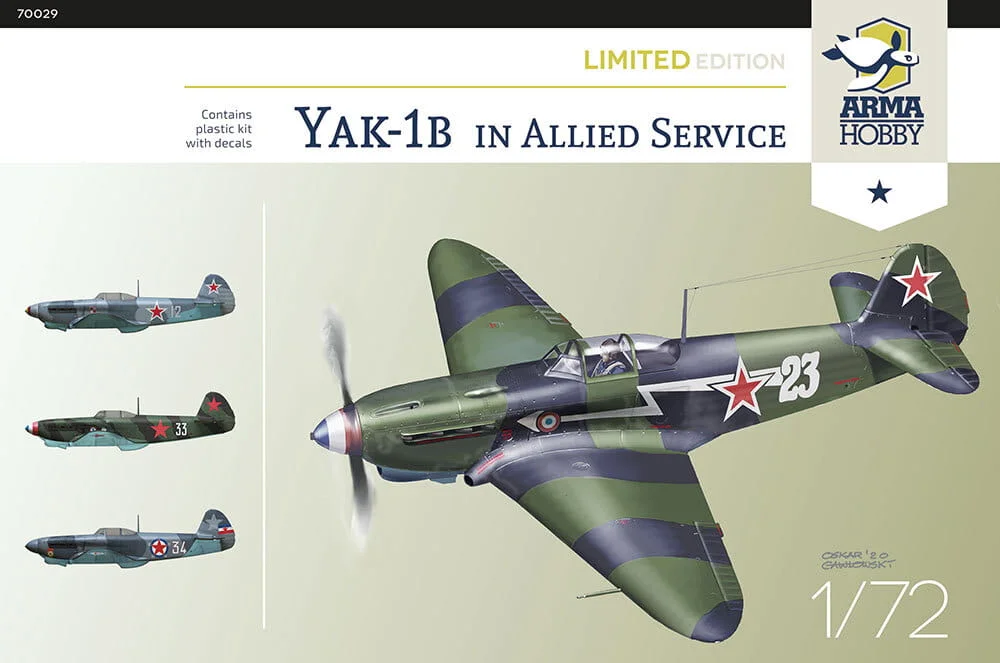
Plastic model kit of the Soviet Yakovlev Yak-1b fighter aircraft in Allied service in 1:72 scale – limited edition
The Yak-1b did not fly in Soviet colours alone – this limited edition is devoted to the machines of Polish, French and Yugoslav pilots. Kit 70029 is based on the 2019 tooling and allows the aircraft to be built in markings rarely seen on modelling shelves.
The model reproduces the "b" version profile with the cut-down rear decking behind the cockpit and the bubble canopy, both introduced to improve the pilot's rearward view. The airframe surfaces distinguish the metal-skinned areas from the fabric and plywood covered ones, in line with the original's mixed construction.
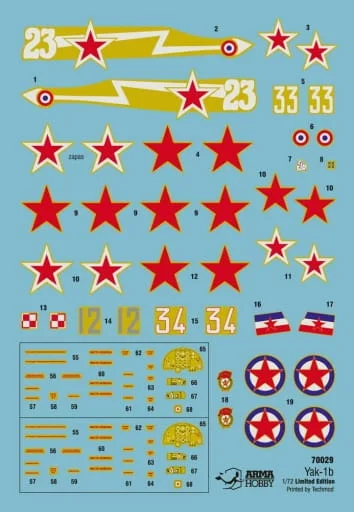
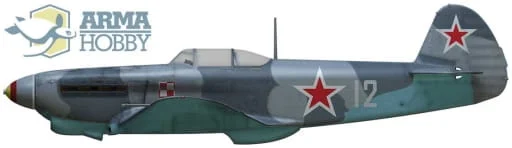
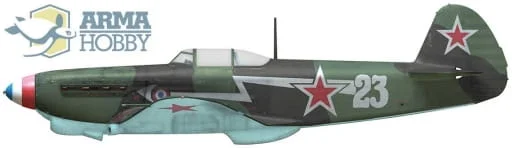
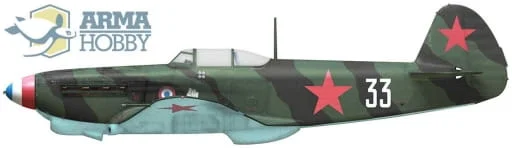
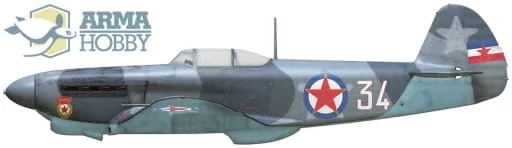
The decals cover four marking options: aircraft no. 12181/12 of the 1st "Warsaw" Fighter Regiment flown by Capt. Oleg Matveyev, 1944/45; aircraft no. 23 of GC3 "Normandie" at Monastyrshchina airfield, October 1943; aircraft no. 33 of Noël Castelain of GC3 "Normandie" at Khatenki airfield, July 1943; and aircraft no. 16173/34 of the 112th Fighter Regiment, Yugoslavia, May 1945.
What's in the box:
- Plastic sprues with the airframe parts
- Sprue with the transparent parts
- Decals for four marking options
- Illustrated assembly instructions
Kit specifications:
- Scale: 1:72
- Catalogue number: 70029
- Manufacturer: Arma Hobby
- Model length when assembled: approx. 118 mm
- Model wingspan: approx. 139 mm
- Skill level: beginner/intermediate (low parts count, small details)
Please note: glue, paints and modelling tools are not included. The model requires assembly.
Building the model:
The kit builds easily – the parts count is low and the sprue breakdown well thought out. We suggest painting and finishing the cockpit before joining the fuselage halves, as it remains clearly visible through the bubble canopy. No masks are included in this boxing, so the glazing is best protected with narrow strips of masking tape or with ready-made masks available separately.
All four schemes are based on the Soviet camouflage of 1943–1945: grey-blue and dark grey upper surfaces (AMT-11 and AMT-12) over light blue undersides (AMT-7), differing mainly in markings and unit identification colours. For the cockpit interior we recommend the Soviet grey-blue interior shade. As much of the fuselage was fabric and plywood covered, a panel line wash is best confined to the metal areas. Applying the decals over a gloss coat helps to limit silvering, with a matt or satin varnish as the final finish.
Tools you will need:
- Modelling side cutters for removing parts from the sprues
- Hobby knife or scalpel
- Files and sanding paper for cleaning up gate marks
- Plastic cement (e.g. Tamiya Extra Thin Cement)
- Precision modelling tweezers for the small parts
- Brushes in various sizes or an airbrush
- Modelling paints (acrylic or enamel)
- A wash to emphasise panel lines and details
- Gloss varnish under the decals and a matt or satin coat for the final finish
- Masking tape for the canopy glazing and the camouflage demarcations
About the aircraft – Yakovlev Yak-1b:
The Yak-1 was the first fighter designed by Alexander Yakovlev's bureau and the starting point of the entire family of Soviet wartime fighters – from the Yak-7 and Yak-9 through to the Yak-3. It was created in the second half of the 1930s in response to a competition for a modern fighter and entered series production in 1940. The aircraft used mixed construction: the fuselage was built around a welded steel tube frame covered with fabric and plywood, while the wing was wooden. This approach reflected the shortage of light alloys in Soviet industry, but it also made mass production and field repairs easier under front-line conditions.
The Yak-1b version, introduced at the end of 1942, was the result of combat experience gathered during the first two years of the war. The most obvious change was the cut-down rear fuselage decking behind the cockpit combined with a bubble canopy, which dramatically improved the pilot's rearward view – previously one of the type's most serious shortcomings. The armament was revised as well: instead of two 7.62 mm ShKAS machine guns, a single 12.7 mm Berezin UBS heavy machine gun was fitted, while the 20 mm ShVAK cannon firing through the propeller hub was retained. The Klimov M-105PF engine of around 1,180 hp gave good performance at low and medium altitudes – exactly where most of the fighting on the Eastern Front took place.
The Yak-1b fought at Stalingrad, over the Kuban and in the Kursk salient. Its pilots included the airmen of the French "Normandie" regiment, leading Soviet aces and the women fighter pilots of the 586th and 73rd fighter regiments – among them Lydia Litvyak, one of the best-known female fighter pilots in history. The type also equipped the 1st "Warsaw" Fighter Regiment, formed in the USSR in 1943 and fighting alongside the Red Army all the way to Berlin. More than 8,700 Yak-1s of all versions were built in total, with the "b" variant accounting for close to half of them.
Original aircraft specifications (Yakovlev Yak-1b):
- Length: 8.48 m
- Wingspan: 10.00 m
- Height: approx. 2.64 m
- Wing area: approx. 17.15 m²
- Empty weight: approx. 2,394 kg
- Take-off weight: approx. 2,880 kg
- Crew: 1
- Powerplant: Klimov M-105PF inline engine of approx. 1,180 hp
- Maximum speed: approx. 590 km/h at approx. 4,300 m
- Service ceiling: approx. 10,000 m
- Range: approx. 700 km
- Armament: one 20 mm ShVAK cannon firing through the propeller hub and one 12.7 mm Berezin UBS heavy machine gun
- Structure: mixed – welded steel tube frame covered with fabric and plywood, wooden wing
- Production: 1940–1944, over 8,700 Yak-1s of all versions built
About the manufacturer – Arma Hobby:
Operating since 2016, Arma Hobby is one of the best-known Polish makers of plastic model kits. The brand descends from Attack Squadron, a Warsaw company that previously specialised in resin accessories, which shows in the level of detail found in its styrene kits. Design is done digitally, frequently based on scans of surviving aircraft, and the tooling is produced in Poland. Typical features include fine rivets and panel lines, thin trailing edges and clear, well-shaped canopies. The catalogue spans 1:72 and 1:48 scales with a strong focus on Polish aviation – the PZL P.7a, PZL P.11c and TS-11 Iskra – as well as Allied fighters of the Second World War. The manufacturer pays particular attention to decal quality and to complete stencilling. Arma Hobby kits have been honoured many times in industry polls, including a Model of the Year title at the Nuremberg trade fair. 3D-printed parts appear in its boxings ever more often, and some releases are supplemented by files for home printing.
Safety warnings
Certificates and safety warnings
- Product not for children under 14 years of age. Use under adult supervision.
- Contains small parts that may present a choking hazard.
- Contains sharp-edged elements.
- Keep out of reach of pets.
Manufacturer
Arma Hobby S.C.
Ostrobramska 101/200
04-041 Warszawa, Poland
Produkty powiązane
-
€7.12
-
€13.79
-
€6.40
-
€5.69
-
€9.74
-
€3.79
-
€3.79
-
€12.60
-
€12.60
-
€15.69
-
€16.88
-
€16.88
-
€20.69


Other products in this category
-
€15.45
-
€46.40
-
€30.45


Special offers
Check out all the deals
-
€8.15Regular price: €9.26-12%Lowest price: €8.15-0%
-
€25.96Regular price: €29.50-12%Lowest price: €29.50-12%
-
€43.35Regular price: €49.26-12%Lowest price: €43.35-0%
-
€16.95Regular price: €19.26-12%Lowest price: €19.26-12%
-
€11.29Regular price: €12.83-12%Lowest price: €11.29--0%
-
€8.36Regular price: €9.50-12%Lowest price: €9.50-12%
-
€12.13Regular price: €13.79-12%Lowest price: €11.50--5%
-
€7.52Regular price: €8.55-12%Lowest price: €8.55-12%
-
€10.66Regular price: €12.12-12%Lowest price: €10.66-0%
-
€16.95Regular price: €19.26-12%Lowest price: €19.26-12%
-
€32.04Regular price: €36.40-12%Lowest price: €31.83--1%
-
€24.07Regular price: €27.36-12%Lowest price: €27.36-12%
-
€8.15Regular price: €9.26-12%Lowest price: €8.15-0%
-
€16.11Regular price: €18.31-12%Lowest price: €16.11-0%
-
€2.49Regular price: €2.83-12%Lowest price: €2.83-12%
-
€15.69Regular price: €17.83-12%Lowest price: €15.69-0%


Bestsellers
-
€202.36Regular price: €238.07-15%Lowest price: €178.55--13%
-
€161.88
-
€66.64
-
€178.55
-
€214.26
-
€249.98
-
€107.12
-
€95.21
-
€166.64
-
€190.45
-
€166.64
-
€321.40
-
€285.69
-
€492.83
-
€214.26
-
€559.50


 Log in with Google

