





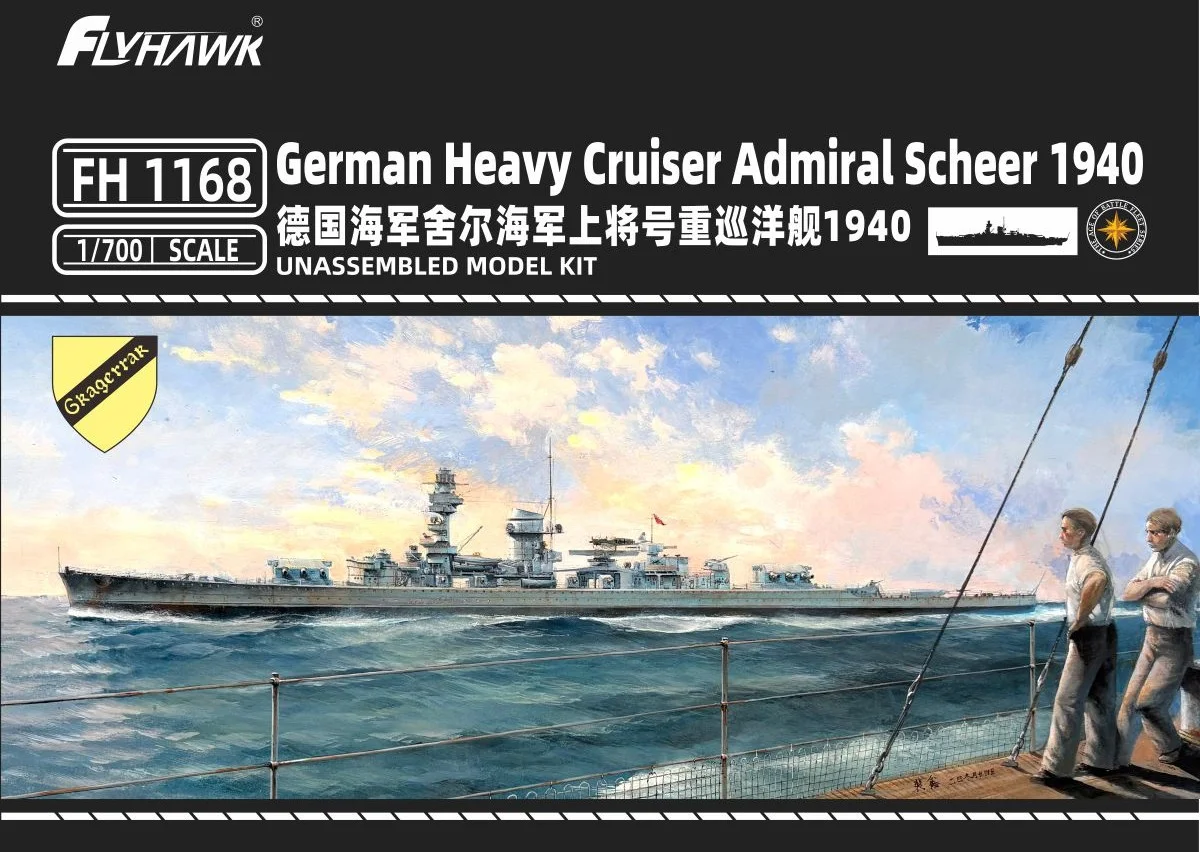


Flyhawk FH1168 - 1:700 German Heavy Cruiser Admiral Scheer 1940
Do darmowej dostawy brakuje Ci jedynie 299 zł
Masz darmową dostawę ✓
Product code: FHM-1168
Barcode: 6921970496942
Ask about the product

Administratorem danych osobowych jest Sklep Modelarski Exito. Przetwarzamy je w celu przesłania odpowiedzi na zapytanie. Więcej informacji dotyczących przetwarzania danych osobowych znajduje się w polityce prywatności.
Share the product card



Leave feedback on the product

Description
Plastic model kit of the German heavy cruiser Admiral Scheer (1940) in 1:700 scale
The Flyhawk FH1168 is a build-it-yourself kit of the Admiral Scheer – the second Deutschland-class ship and one of the most recognisable vessels of the Kriegsmarine. The slim, predatory silhouette of these ships resulted from a compromise imposed by the Treaty of Versailles: within a limited displacement, German designers combined heavy 28 cm guns with a long operational range thanks to a welded hull and an all-diesel powerplant.
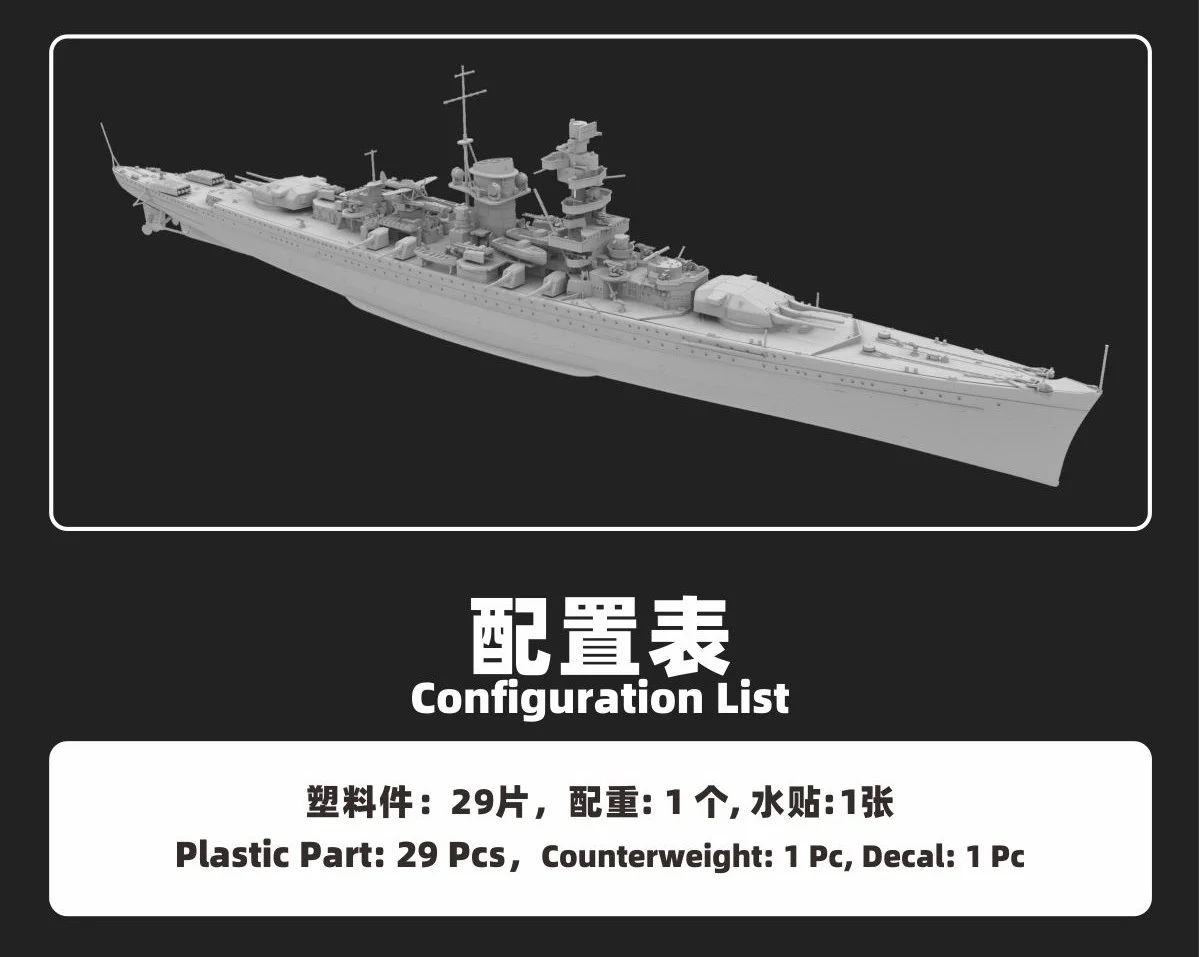
The model represents the ship in her 1940 configuration, the period in which the Deutschland-class vessels were formally reclassified from armoured ships ("Panzerschiff") to heavy cruisers. The hull is rendered with the characteristic conning tower, masts, funnel and the arrangement of two triple main-battery turrets and single secondary mounts. The fine detailing of the superstructure and deck is typical of Flyhawk kits in this scale.
What's in the box:
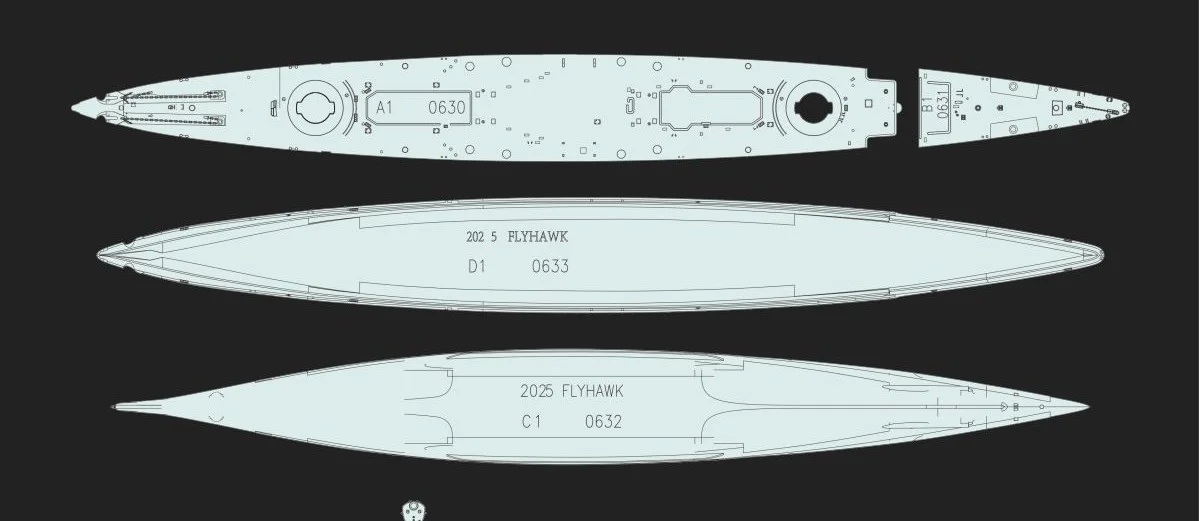
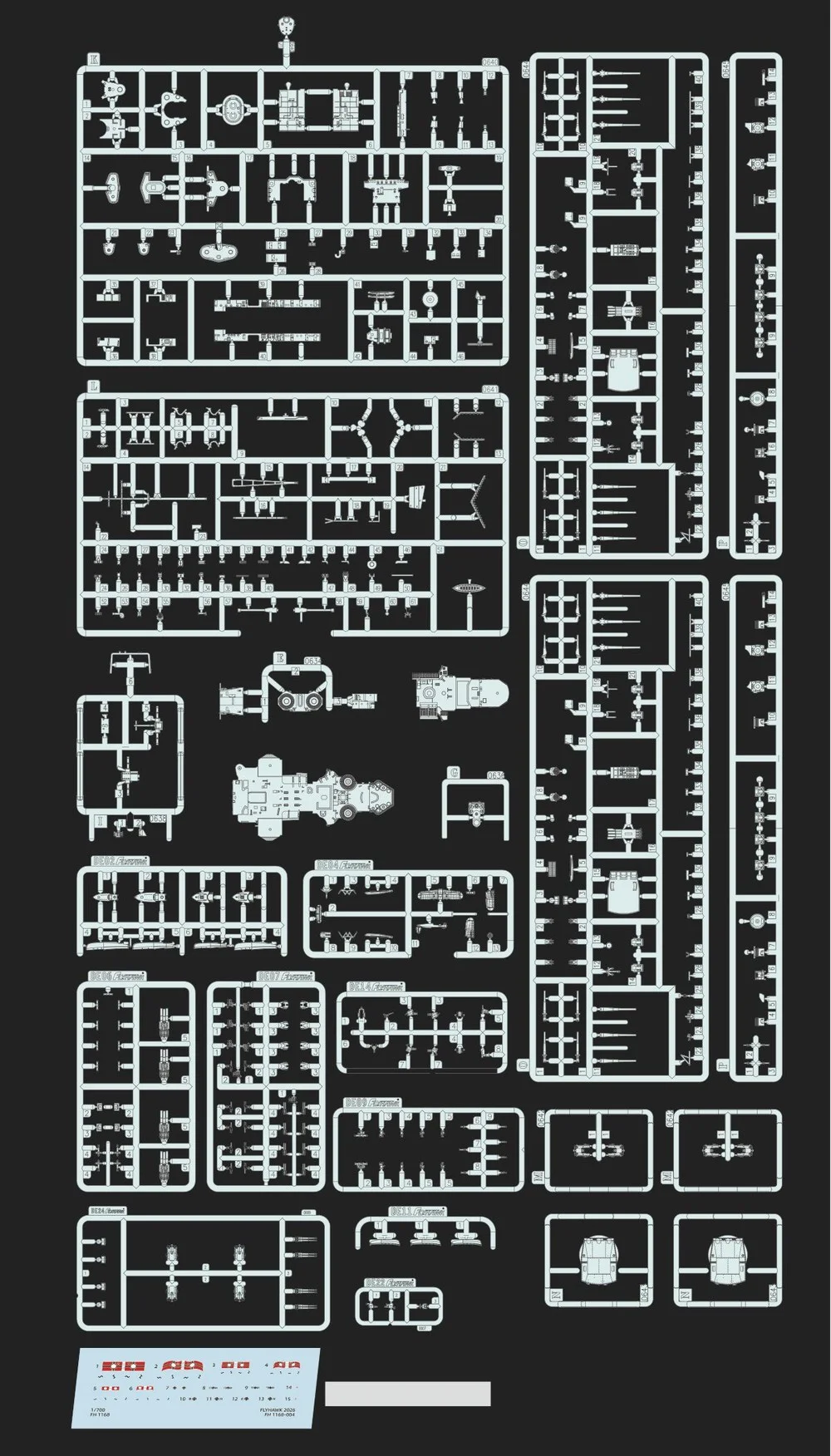
- Injection-moulded plastic parts (hull, superstructure, armament, deck fittings)
- Waterslide decal sheet
- Illustrated assembly instructions
Model specifications:
- Scale: 1:700
- Catalogue number: FH1168
- Manufacturer: Flyhawk
- Assembled length: approx. 266 mm
- Skill level: intermediate
Please note: This kit does not include cement, paints or modelling tools. The model is intended for self-assembly.
Assembly:
The small 1:700 scale calls for care when cleaning up and gluing the tiny superstructure and armament parts, so the kit is best suited to modellers with some experience. It is worth taking time to remove the sprue-gate marks neatly on the thin parts in order to preserve crisp detail.
For an early-war Kriegsmarine scheme we suggest the typical naval greys: a dark grey hull (e.g. Tamiya XF-24 Dark Grey), lighter superstructure (e.g. Tamiya XF-19 Sky Grey) and a red underbody (e.g. Tamiya XF-9 Hull Red). For modellers who want to raise the level of detail, we recommend the Deluxe edition (Flyhawk FH1168S) with photo-etched parts and turned metal barrels, or separate detail sets available in our shop.
Recommended tools:
- Modelling nippers for removing parts from the sprues
- Hobby knife or scalpel
- Files and sandpaper for smoothing sprue-gate marks
- Plastic cement (e.g. Tamiya Extra Thin Cement)
- Precision modelling tweezers
- Brushes of various sizes
- Modelling paints (acrylic or enamel)
- Modelling wash to emphasise detail and recesses
About the ship – Admiral Scheer:
Admiral Scheer was the second of three Deutschland-class ships – vessels the British press soon nicknamed "pocket battleships". They were built in response to the Treaty of Versailles, which permitted Germany warships of a nominal displacement of up to 10,000 tons with guns of up to 28 cm calibre. To fit such heavy armament into so small a hull, German engineers adopted innovations that were radical at the time: a welded hull and a powerplant made up exclusively of diesel engines, giving excellent operational range. The ship was named after Admiral Reinhard Scheer, commander of the High Seas Fleet at the Battle of Jutland.
She was launched in 1933 at Wilhelmshaven and commissioned in November 1934. In February 1940 the Deutschland-class ships were reclassified as heavy cruisers. The most famous episode in Admiral Scheer's career was her long Atlantic raiding sortie in the winter of 1940–1941, during which she attacked Allied convoys and lone merchant ships, clashing with the British armed merchant cruiser HMS Jervis Bay escorting convoy HX 84. In terms of tonnage sunk it was the most successful commerce-raiding cruise by a major Kriegsmarine warship.
Later in the war Admiral Scheer operated in Arctic waters against convoys bound for the USSR, and in the final period supported land forces with gunfire in the Baltic. She was sunk on 9 April 1945 at Kiel during an Allied air raid.
Original ship specifications (Admiral Scheer, 1940):
- Length: 186 m
- Beam: 21.34 m
- Draught: approx. 7.25 m
- Displacement: approx. 13,660 t (design), approx. 15,400 t (full load)
- Propulsion: 8 MAN diesel engines, 2 shafts, approx. 54,000 hp total
- Maximum speed: approx. 28 knots
- Range: approx. 9,100 nautical miles at 20 knots
- Complement: approx. 1,000
- Main armament: 6 × 28 cm guns in two triple turrets
- Secondary armament: 8 × 15 cm guns in single mounts
- Anti-aircraft armament: 10.5 cm, 3.7 cm and 2 cm guns (varying by period)
- Torpedo armament: 8 × 533 mm torpedo tubes
- Armour: turrets up to 140 mm, belt 80 mm, deck 45 mm
- Aviation: 1 catapult-launched floatplane (Arado Ar 196)
About the manufacturer – Flyhawk:
Flyhawk is a Chinese manufacturer of scale models, known above all for 1:700 warships as well as military vehicle kits. The brand has earned its reputation through highly precise tooling, an abundance of fine detail and modern renderings of Second World War subjects. A signature feature of Flyhawk's range is its Deluxe editions, in which the standard plastic kit is supplemented with photo-etched parts, turned metal barrels and resin components. The company also develops its own line of detail and upgrade sets for its models, allowing modellers to gradually raise the level of detail of the finished ship. Flyhawk kits are valued by collectors and naval-history enthusiasts worldwide.
Safety warnings
Certificates and safety warnings
- Product not for children under 14 years of age. Use under adult supervision.
- Contains small parts that may present a choking hazard.
- Contains sharp-edged elements.
- Keep out of reach of pets.
Manufacturer
Chongqing Jihae Crafts Co., Ltd.
KeYuan 6th Road 293-2
. Chongqing, China
Responsible person in the EU
Modellbaukönig GmbH & Co KG
Nordenhamer Str. 177
27751 Delmenhorst, Germany
Other products in this category
-
€46.17
-
€55.21
-
€45.93
-
€77.36
-
€33.31
-
€78.55
-
€131.40
-
€84.98
-
€37.36
-
€114.74
-
€84.98
-
€66.64
-
€142.83
-
€47.36
-
€73.79
-
€38.07


Special offers
Check out all the deals
-
€41.31Regular price: €51.64-20%Lowest price: €43.90-6%
-
€48.20Regular price: €64.26-25%Lowest price: €51.41-6%
-
Deal
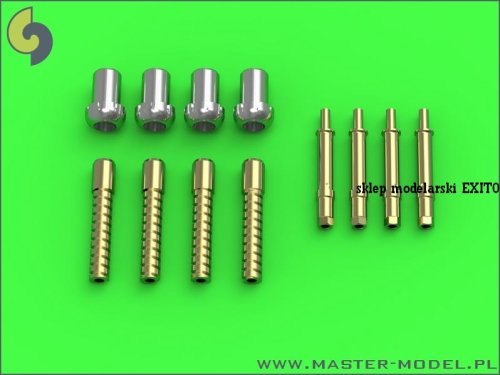
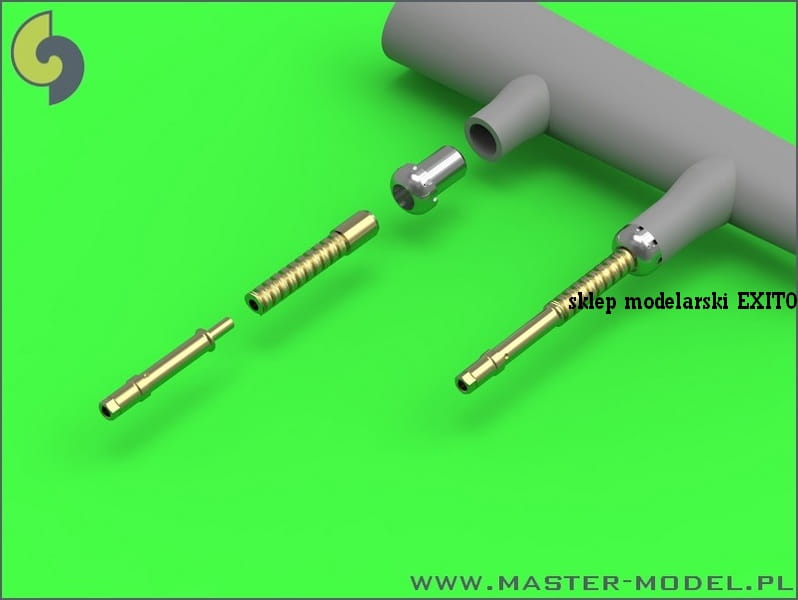
MASTER AM-24-009 - 1:24 Hawker Hurricane Mk IIC gun barrels for Hispano Mk and 20mm with flat spring
€11.13Regular price: €18.55-40%Lowest price: €11.13-0% -
€3.13Regular price: €5.21-40%Lowest price: €3.13-0%
-
€20.93Regular price: €26.17-20%Lowest price: €20.93-0%
-
€24.56Regular price: €40.93-40%Lowest price: €24.56-0%
-
€9.89Regular price: €12.36-20%Lowest price: €9.89-0%
-
€19.03Regular price: €23.79-20%Lowest price: €19.03-0%
-
€18.08Regular price: €22.60-20%Lowest price: €18.08-0%
-
€15.22Regular price: €19.02-20%Lowest price: €15.22-0%
-
€13.12Regular price: €16.40-20%Lowest price: €13.12-0%
-
€12.55Regular price: €15.69-20%Lowest price: €12.55-0%
-
€10.46Regular price: €13.07-20%Lowest price: €10.46-0%
-
€45.72Regular price: €53.79-15%Lowest price: €45.72-0%
-
€26.90Regular price: €31.64-15%Lowest price: €26.90-0%
-
€52.17Regular price: €65.21-20%Lowest price: €55.43-6%


Bestsellers
-
€238.07
-
€161.88
-
€66.64
-
€178.55
-
€107.12
-
€166.64
-
€166.64
-
€249.98
-
€321.40
-
€190.45
-
€214.26
-
€214.26
-
€95.21
-
€492.83
-
€209.50
-
€559.50


 Log in with Google

