





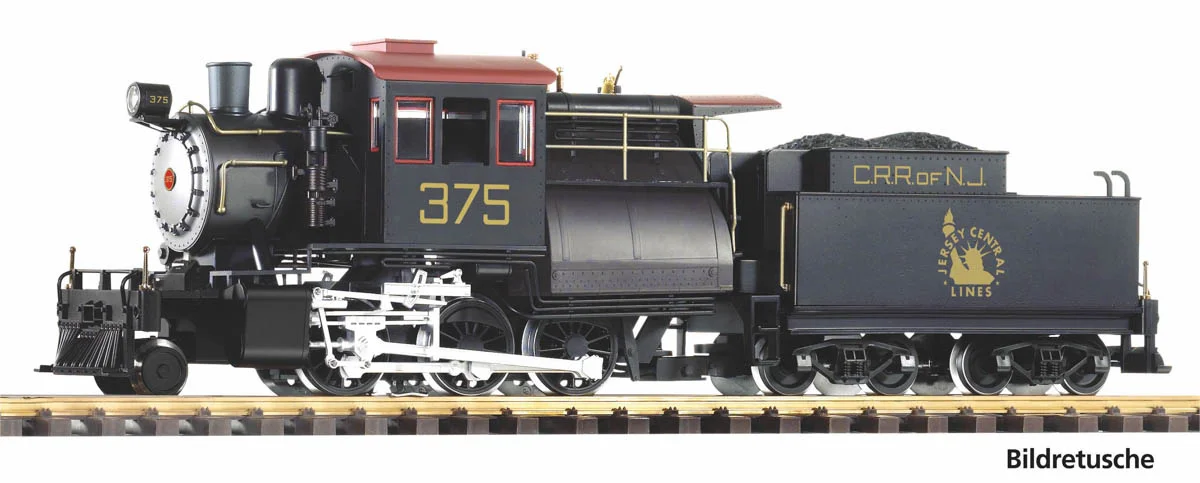
Piko 38280 G - CNJ Camelback Tender Steam Locomotive, R/C, with sound
Do darmowej dostawy brakuje Ci jedynie 299 zł
Masz darmową dostawę ✓
Product code: PIKO-38280
Barcode: 4015615382805
Ask about the product

Administratorem danych osobowych jest Sklep Modelarski Exito. Przetwarzamy je w celu przesłania odpowiedzi na zapytanie. Więcej informacji dotyczących przetwarzania danych osobowych znajduje się w polityce prywatności.
Share the product card



Leave feedback on the product

Description
Model of a camelback steam locomotive with tender in Central Railroad of New Jersey livery
American anthracite-burning steam locomotives solved their fuel problem in a way that still looks eccentric today: since the firebox had to be very wide, the cab was moved forward and placed astride the boiler. This model reproduces exactly such a machine — a camelback with tender in Central Railroad of New Jersey colours, carrying road number 375. It is built to G scale for garden layouts running on 45 mm gauge track, and measures 525 mm over buffers including the tender.
Body and tender carry careful paintwork with precise lettering of the American railroad. The model has a working smoke generator and direction-dependent lights, white at both ends. A PIKO sound decoder with the Tri-Mode Sound system is fitted at the factory, reproducing among other things the exhaust chuff and the air pump, with whistle and bell available as playable functions. The drive is designed for battery operation with radio control, so the locomotive can run on unpowered track — a genuinely practical advantage outdoors. Construction and materials are chosen for garden railway service.
Model specifications:
- Scale: G (45 mm gauge track)
- Item number: 38280
- Manufacturer: PIKO
- Length over buffers including tender: 525 mm
- Railway administration: CNJ (Central Railroad of New Jersey)
- Vehicle type: camelback steam locomotive with tender, road number 375
- PIKO sound decoder factory fitted
- Tri-Mode Sound system: analogue DC track, DCC digital control and on-board battery with radio control
- Smoke generator
- Lighting: direction-dependent light change, white / white
- Minimum radius: 600 mm
- Ready to run, factory painted and assembled
- Age recommendation: 14 years and up
Please note: running this model requires either powered track or a battery pack with radio control.
The model is not a starter set and includes neither track nor a controller. Thanks to the Tri-Mode Sound system it can be operated in three ways: from track supplied with direct current, from digitally controlled DCC track, and wirelessly from a battery carried on board. For digital operation you need a DCC command station, for example PIKO SmartControl or any other DCC compatible controller, connected to powered track. Running on analogue DC track is possible only as long as the decoder still has its alternative power source setting enabled, that is analogue operation — in the DCC standard this is governed by bit 2 of configuration register CV29. The function is active by default, but if it has previously been switched off, applying direct current to the track may damage the decoder. In analogue mode only basic running is available, without full control of the digital functions.
Model railways – digital or analogue control?
In an analogue system speed and direction follow from the voltage applied to the rails, so every vehicle on the same track section reacts in the same way. In a DCC digital system the track carries a constant voltage while the command station sends addressed instructions through it, so each locomotive is driven individually and sound, lights or smoke can be switched independently. This model adds a third option — battery power with radio control, independent of rail condition and cleanliness, which matters a great deal in a garden setting.
About camelback steam locomotives:
It all started with fuel. In the second half of the nineteenth century, enormous quantities of culm and waste from anthracite mining piled up in Pennsylvania with no buyers. In the mid-1870s John E. Wootten designed a firebox with a very large grate area capable of burning this cheap material. The first locomotives with a Wootten firebox were built by the Reading shops in Pennsylvania in 1877.
The trouble was that such a wide firebox blocked the driver's forward view. The solution was radical: the cab was moved to the middle of the boiler, where the engineer sat astride the boiler barrel, while the fireman stayed behind on an exposed platform by the tender. Hence the popular names of these machines — camelback and Mother Hubbard. The layout was built in many wheel arrangements, from 0-4-0 and 0-6-0 switchers through 2-6-0 and 2-8-0 types to 4-6-0 ten-wheelers and the largest articulated 0-8-8-0 examples.
Camelbacks became a hallmark of the anthracite region railroads, above all the Central Railroad of New Jersey and the Reading. The CNJ itself grew out of the Elizabethtown & Somerville Railroad of 1831 and was organised as the Central Railroad Company of New Jersey in 1849; its network reached from Jersey City through Phillipsburg as far as Wilkes-Barre and Scranton in the coal country. This was the same railroad that in 1929 launched the celebrated Blue Comet from Jersey City to Atlantic City. The divided cab came at a price, however: engineer and fireman could barely communicate, and the crew worked dangerously close to moving machinery. For that reason the Interstate Commerce Commission banned construction of new locomotives of this type in 1918, with final regulations issued in 1927. Five examples survive today, among them CNJ number 592 at the B&O Railroad Museum in Baltimore.
Prototype specifications (camelback steam locomotive):
- Wheel arrangement of the modelled locomotive: 2-6-0 (Mogul type)
- Design feature: wide Wootten firebox with the cab mounted on the boiler
- Fuel: anthracite and waste culm from anthracite mining
- First locomotives with a Wootten firebox: 1877, Reading company shops
- Construction of new locomotives of this type banned: 1918, final regulations 1927
- Principal users: Central Railroad of New Jersey and the Reading
- Duties: passenger, freight and switching work in the anthracite region
- Survivors: five, including CNJ 592 at the B&O Railroad Museum
About the manufacturer – PIKO:
PIKO is a German model railway manufacturer whose history began in 1949 with the works at Sonneberg in Thuringia. Over more than seventy years the brand has become one of the most widely known in Europe, with a catalogue covering H0, TT, N and G scales. The last of these is the domain of garden railways — G scale models are designed for outdoor service, resistant to moisture and sunlight and detailed at a size that reads well from a distance. PIKO also develops this line in American subjects, offering United States prototypes alongside classic European stock. The company is likewise a major producer of Polish prototype models for PKP, PKP Intercity and PKP Cargo.
Safety warnings
Certificates and safety warnings
- This product is a collector's item intended for users aged 14 and above, and is not a toy for children.
- Before use, read the user manual, use the product as intended and follow the safety instructions contained in the manual and on the packaging.
- May contain small parts that pose a choking/swallowing hazard.
- Use indoors. Protect from moisture and water, which may damage electrical or mechanical components.
- Use the product only when it is in perfect condition.
- Do not use a damaged power cord or power supply. If the cord or power supply shows signs of damage, replace it immediately with original accessories recommended by the manufacturer.
- The product may only be used by children under adult supervision.
- Use only with recommended accessories and additional components.
- Ensure good ventilation: do not block ventilation openings, do not cover devices and do not use in closed, heated spaces.
- Do not expose to prolonged sunlight.
- Before connecting to the power supply, check that the voltage in the socket meets the requirements specified in the manual.
- Do not touch the rails when the control panel is live.
- Do not place metal objects on the rails; this may cause a short circuit and damage the system.
- Disconnect the power supply from the mains after use.
- Do not disassemble the device. Disassembling the controller, control panel or power supply yourself may damage the equipment, void the warranty and cause electric shock.
- If the product has stopped functioning properly, contact customer service/support.
Manufacturer
PIKO Spielwaren GmbH
Lutherstraße 30
96515 Sonneberg, Germany
Other products in this category
-
€271.40
-
€999.98
-
€619.02
-
€880.93
-
€797.60
-
€1,380.93
-
€714.26


Special offers
Check out all the deals
-
Deal
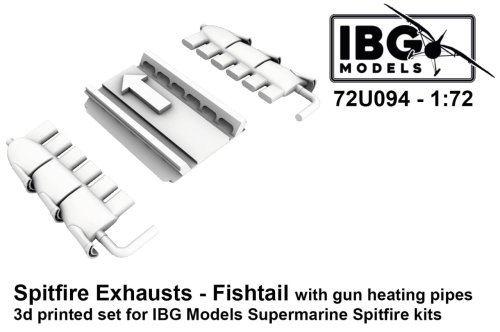
IBG 72U094 - 1:72 Supermarine Spitfire Exhausts Fishtail Type with gun heating pipes 3D Printed Set
€5.01Regular price: €5.69-12%Lowest price: €5.69-12% -
€13.18Regular price: €14.98-12%Lowest price: €14.98-12%
-
€29.94Regular price: €34.02-12%Lowest price: €29.94-0%
-
€18.21Regular price: €20.69-12%Lowest price: €20.69-12%
-
€49.01Regular price: €55.69-12%Lowest price: €55.69-12%
-
€105.16Regular price: €119.50-12%Lowest price: €105.16-0%
-
€8.99Regular price: €10.21-12%Lowest price: €10.21-12%
-
€46.91Regular price: €53.31-12%Lowest price: €53.31-12%
-
€43.35Regular price: €49.26-12%Lowest price: €49.26-12%
-
€6.68Regular price: €7.60-12%Lowest price: €7.60-12%
-
€38.32Regular price: €43.55-12%Lowest price: €43.55-12%
-
€50.05Regular price: €56.88-12%Lowest price: €56.88-12%
-
€16.32Regular price: €18.55-12%Lowest price: €16.32-0%
-
€11.29Regular price: €12.83-12%Lowest price: €12.83-12%
-
€20.72Regular price: €23.55-12%Lowest price: €23.55-12%
-
€8.36Regular price: €9.50-12%Lowest price: €9.50-12%




Bestsellers
-
€202.36Regular price: €238.07-15%Lowest price: €178.55--13%
-
€161.88
-
€66.64
-
€178.55
-
€214.26
-
€249.98
-
€107.12
-
€95.21
-
€166.64
-
€190.45
-
€166.64
-
€321.40
-
€285.69
-
€492.83
-
€214.26
-
€559.50


 Log in with Google
