





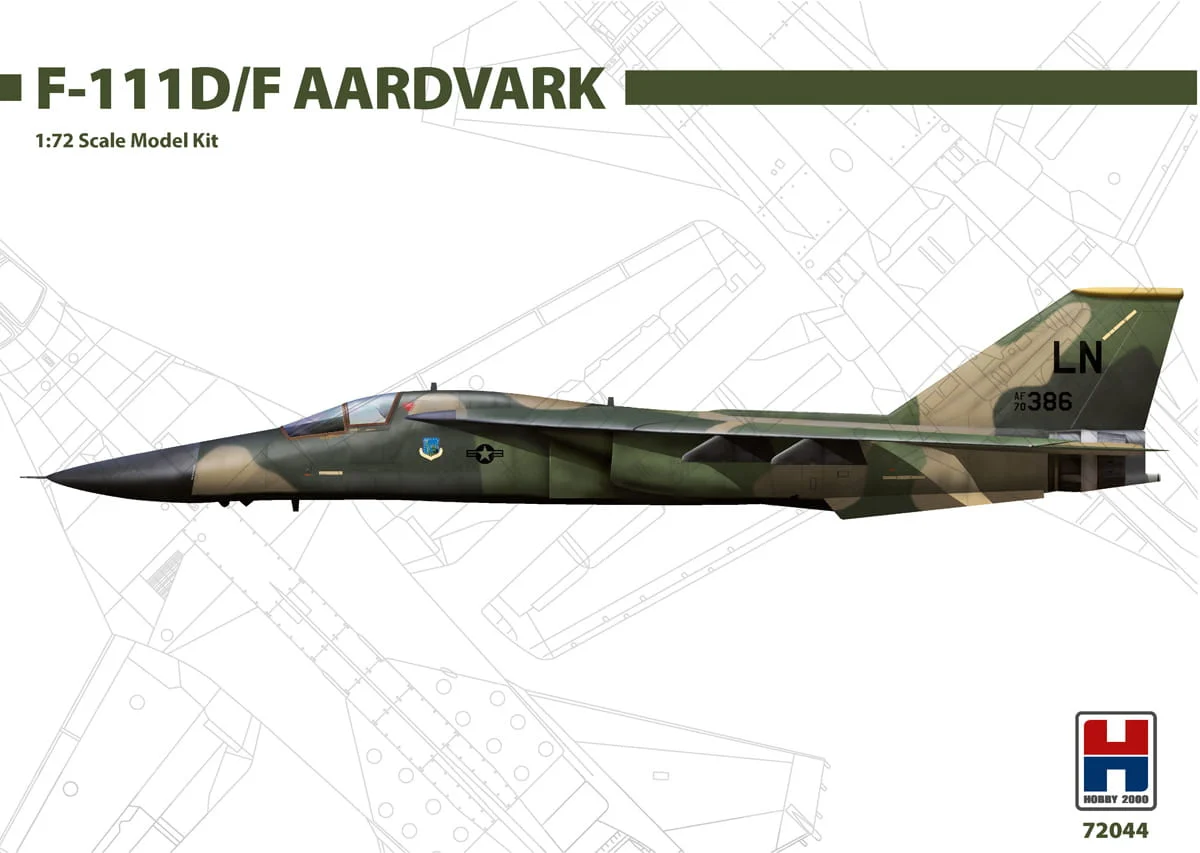
Hobby 2000 72044 - 1:72 F-111 D/F Aardvark
Do darmowej dostawy brakuje Ci jedynie 299 zł
Masz darmową dostawę ✓
Product code: H2K-72044
Barcode: 5903002057445
Ask about the product

Administratorem danych osobowych jest Sklep Modelarski Exito. Przetwarzamy je w celu przesłania odpowiedzi na zapytanie. Więcej informacji dotyczących przetwarzania danych osobowych znajduje się w polityce prywatności.
Share the product card



Leave feedback on the product

Description
Plastic model kit of the General Dynamics F-111D/F Aardvark strike aircraft in 1:72 scale
Hobby 2000 72044 presents the F-111, the first production combat aircraft with variable-geometry wings, known in service by the nickname "Aardvark". The kit covers two versions: the D, fitted with Mark II avionics, and the F, the most developed and most effective strike variant of the family.
It is based on Hasegawa mouldings supplemented with new parts that allow the differences between the two versions to be reproduced. The wings can be positioned spread or swept, which on a model this size gives two completely different silhouettes on the shelf. Hobby 2000 adds its own box, illustrated instructions, self-adhesive masks for the canopy glazing and waterslide decals printed by Cartograf.
What's in the box:
- Plastic sprues with fuselage, wing and detail parts
- New parts allowing the model to be built as the D or the F version
- Parts for underwing stores
- Clear parts for the canopy glazing
- Self-adhesive masks for the canopy glazing
- Waterslide decal sheet printed by Cartograf
- Illustrated assembly instructions
Kit specifications:
- Scale: 1:72
- Catalogue number: 72044
- Manufacturer: Hobby 2000
- Assembled length: approx. 311 mm
- Assembled wingspan: approx. 267 mm with wings spread and approx. 135 mm with wings swept
- Skill level: intermediate
Note: The kit does not include glue, paints or modelling tools. The model requires assembly.
Assembly:
It is worth deciding which version - D or F - to build before starting, as the choice affects parts selection early in the sequence. The next key point is the variable-geometry wing mechanism: careful seating of the pivots when closing the fuselage keeps both wings symmetrical. The cockpit interior is best painted and finished before the fuselage is closed up.
Over their service life F-111s wore everything from the light schemes of the 1970s to the dark strike camouflage of the 1980s and 1990s; the instructions give paint references for the option on the decal sheet. Given the large surface area an airbrush works better than a brush. Decals applied over a gloss coat are less prone to silvering, and a satin varnish suits the final finish. A panel-line wash brings out the divisions of the large airframe, and subtle exhaust staining behind the nozzles adds realism.
Tools you will need:
- Modelling nippers for removing parts from the sprues
- Hobby knife or scalpel
- Files and sanding paper for cleaning up sprue gate marks
- Plastic cement (e.g. Tamiya Extra Thin Cement)
- Fine modelling tweezers
- Airbrush or brushes in various sizes
- Modelling paints (acrylic or enamel)
- Gloss varnish for decalling and satin varnish for the final finish
- A wash to accentuate detail
About the aircraft - General Dynamics F-111:
The F-111 was the first combat aircraft with variable-geometry wings to enter operational service. It emerged in the first half of the 1960s from the controversial TFX programme, which aimed to produce a single aircraft for both the air force and the navy. The naval version never entered production, but with the US Air Force the F-111 established itself as a tactical bomber with capabilities no other design possessed at the time: it could fly long distances at night and in any weather at very low altitude, automatically following the contours of the terrain using its terrain-following radar.
With the wings spread the aircraft had the lift needed for take-off and landing; swept back, they allowed supersonic speed at low level. The two crew members sat side by side in a cockpit that in an emergency was jettisoned complete as an escape capsule - a solution unique in this class of aircraft. Large internal fuel tanks and eight weapons stations gave range and payload comparable to a medium bomber.
Its combat debut in Vietnam in 1968 was troubled, but once the systems matured the F-111 became one of the most effective strike aircraft of the Cold War. The F-111F, with more powerful engines and the Pave Tack targeting pod, was the principal carrier of laser-guided bombs - it took part in the 1986 raid on Libya and played a leading role in Operation Desert Storm in 1991, destroying hundreds of point targets including Iraqi armoured vehicles. The last examples left US service in 1998.
Original aircraft specifications (General Dynamics F-111F):
- Length: 22.4 m
- Wingspan: 19.2 m (wings spread) / 9.74 m (wings swept)
- Height: approx. 5.2 m
- Empty weight: approx. 21,500 kg
- Maximum take-off weight: approx. 45,000 kg
- Crew: 2 (pilot and weapon systems officer, seated side by side)
- Powerplant: two Pratt & Whitney TF30 afterburning turbofans (F version: TF30-P-100, D version: TF30-P-9)
- Maximum speed: approx. Mach 2.5 at altitude
- Service ceiling: approx. 20,000 m
- Armament: up to approx. 14,000 kg of stores on underwing stations and in the internal bay
- Special equipment: terrain-following radar, crew escape capsule
- Production: F-111D - 96 examples, F-111F - 106 examples; all F-111 versions - 563 examples
About the manufacturer - Hobby 2000:
Hobby 2000 is a Polish model company based in Katowice that has built its position on themed releases. Its kits are based on mouldings from established manufacturers - in this case Hasegawa - completed with original packaging, new illustrated instructions and fresh waterslide decals printed by the Italian printing house Cartograf. Most aircraft releases also include self-adhesive masks for the canopy glazing, which noticeably simplifies painting. The brand favours subjects connected with Polish aviation history as well as less obvious episodes of the Second World War and the post-war years, selecting its marking options from archival material. Production runs are limited, so individual releases are often sought after by collectors. For the modeller this means proven, well-detailed mouldings combined with subjects not available in the original boxings. The company's catalogue covers aircraft, vehicles and ships in scales from 1:72 to 1:35.
Safety warnings
Certificates and safety warnings
- Product not for children under 14 years of age. Use under adult supervision.
- Contains small parts that may present a choking hazard.
- Contains sharp-edged elements.
- Keep out of reach of pets.
Manufacturer
Hobby 2000 Sp. z o.o.
ul. Tadeusza Kościuszki 227
www.hobby2000.pl
40-600 Katowice, Poland
Other products in this category
-
€28.47Lowest price: €32.36-12%
-
€15.21
-
€16.53Lowest price: €18.79-12%
-
€42.83
-
€16.40
-
€28.47Lowest price: €32.36-12%
-
€16.40
-
€28.47Lowest price: €32.36-12%
-
€16.40


Special offers
Check out all the deals
-
€40.84Regular price: €46.40-12%Lowest price: €46.40-12%
-
€25.12Regular price: €28.55-12%Lowest price: €25.12-0%
-
€36.65Regular price: €41.64-12%Lowest price: €41.64-12%
-
€6.05Regular price: €6.88-12%Lowest price: €6.88-12%
-
€27.22Regular price: €30.93-12%Lowest price: €30.93-12%
-
€37.27Regular price: €42.36-12%Lowest price: €42.36-12%
-
€25.96Regular price: €29.50-12%Lowest price: €29.50-12%
-
€8.78Regular price: €9.98-12%Lowest price: €9.98-12%
-
€7.10Regular price: €8.07-12%Lowest price: €7.36-4%
-
€23.45Regular price: €26.64-12%Lowest price: €26.64-12%
-
€14.65Regular price: €16.64-12%Lowest price: €14.85-1%
-
€16.95Regular price: €19.26-12%Lowest price: €19.26-12%
-
€12.55Regular price: €14.26-12%Lowest price: €12.55-0%
-
€8.36Regular price: €9.50-12%Lowest price: €9.50-12%
-
€13.18Regular price: €14.98-12%Lowest price: €13.18-0%
-
€37.27Regular price: €42.36-12%Lowest price: €42.36-12%


Bestsellers
-
€202.36Regular price: €238.07-15%Lowest price: €178.55--13%
-
€161.88
-
€66.64
-
€178.55
-
€214.26
-
€249.98
-
€107.12
-
€95.21
-
€166.64
-
€190.45
-
€166.64
-
€321.40
-
€285.69
-
€492.83
-
€214.26
-
€559.50


 Log in with Google
