





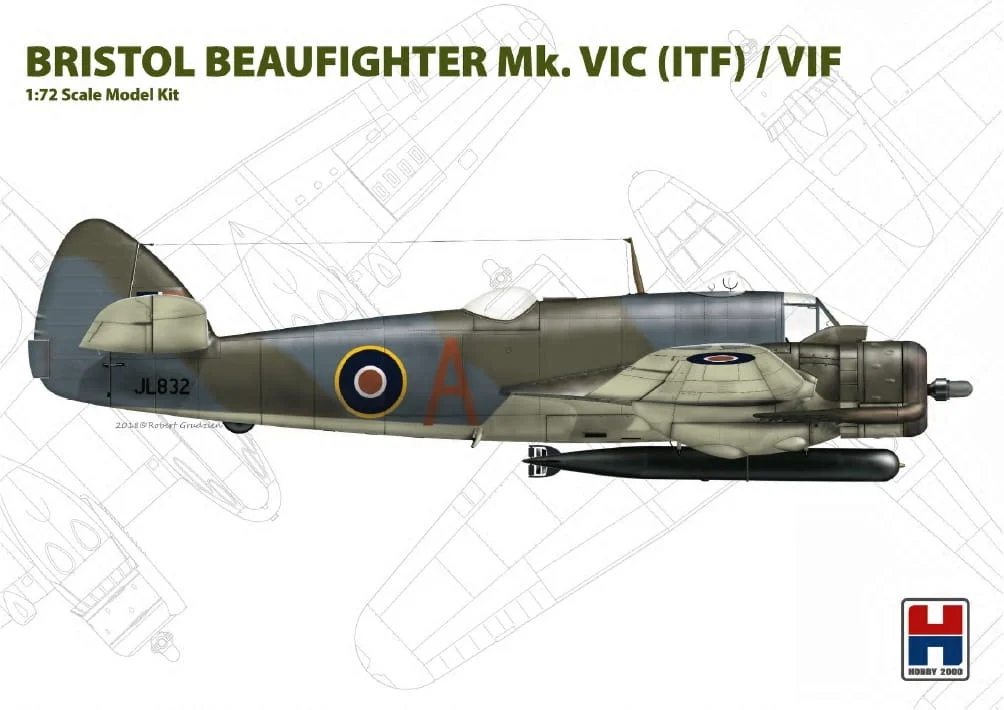


Hobby 2000 72004 - 1:72 Beaufighter Mk. VIC ITF/ VIF
Do darmowej dostawy brakuje Ci jedynie 299 zł
Masz darmową dostawę ✓
Product code: H2K-72004
Barcode: 5903002057032
Ask about the product

Administratorem danych osobowych jest Sklep Modelarski Exito. Przetwarzamy je w celu przesłania odpowiedzi na zapytanie. Więcej informacji dotyczących przetwarzania danych osobowych znajduje się w polityce prywatności.
Share the product card



Leave feedback on the product

Description
1:72 plastic model kit of the Bristol Beaufighter Mk.VIC ITF / Mk.VIF
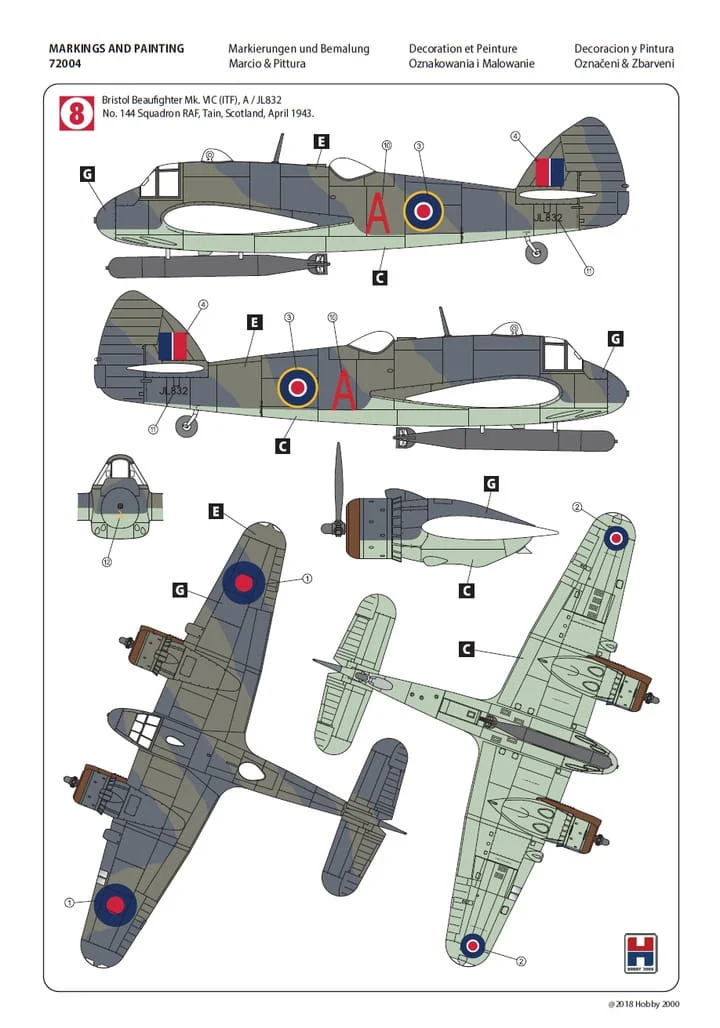
Hobby 2000 72004 is a self-assembly model of the Bristol Beaufighter in its Mk.VI versions – both the Mk.VIC ITF torpedo variant, adapted to carry an aerial torpedo, and the Mk.VIF night fighter with airborne interception radar.
The kit is based on Hasegawa plastic with recessed panel lines. Hobby 2000 has added resin exhaust stacks, which render the characteristic Mk.VI exhaust arrangement with sharper detail than injection moulding allows, along with self-adhesive canopy masks.
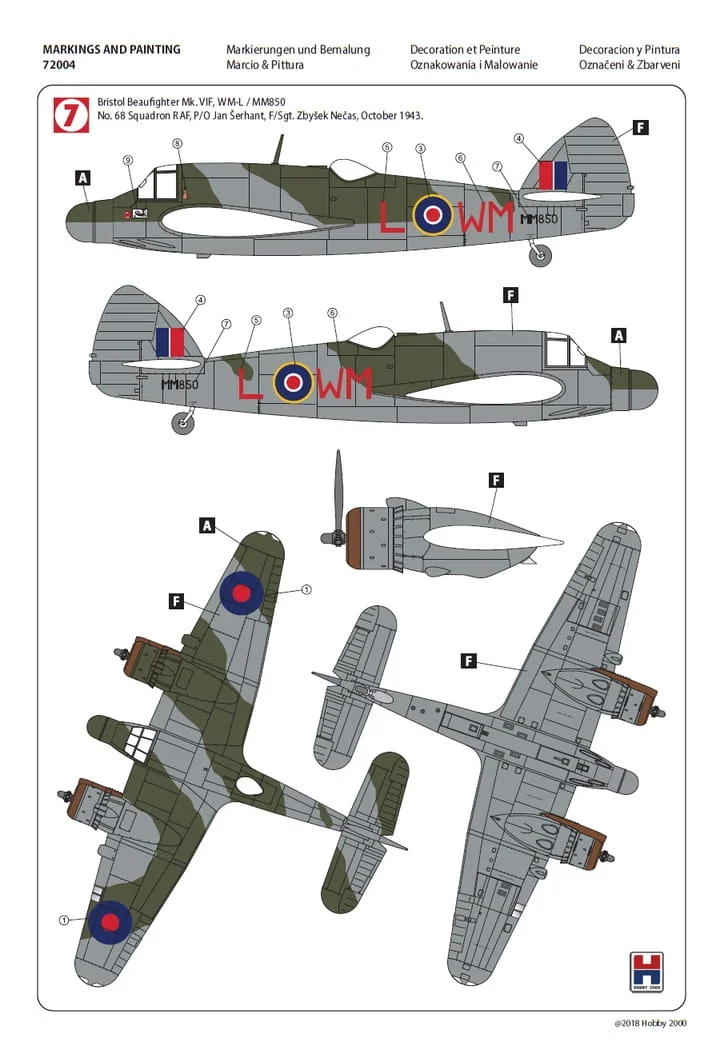
The marking options on the Cartograf-printed decal sheet include Mk.VIF aircraft coded WM-L, serial MM850, of No. 68 Squadron RAF, flown in October 1943 by the Czechoslovak crew of P/O Jan Serhant and F/Sgt Zbysek Necas.
What's in the box:
- Plastic sprues (Hasegawa tooling)
- Resin exhaust stacks specific to the Mk.VI version
- Self-adhesive masks for the canopy glazing
- Waterslide decal sheet printed by Cartograf
- Illustrated assembly instructions
Model specifications:
- Scale: 1:72
- Catalogue number: 72004
- Manufacturer: Hobby 2000
- Assembled model length: approx. 175 mm
- Assembled wingspan: approx. 245 mm
- Skill level: intermediate
Note: The kit does not include glue, paints or modelling tools. The model is intended for self-assembly.
Assembly:
Assembly calls for the care typical of twin-engine kits when it comes to the nacelles and tail surfaces – dry-fitting these parts first pays off. The resin exhaust stacks are separated from their casting blocks with a razor saw, sanded flat and attached with cyanoacrylate glue. The cockpit and observer's station are best painted before the fuselage is closed up.
The choice of version drives the paint scheme: Coastal Command torpedo aircraft generally wore grey-green maritime camouflage over light undersides, while night fighters carried dark colours with a matt finish. Applying the decals over a gloss coat limits silvering, and a satin varnish suits the final finish. Turned metal pitot tubes or a seat belt set, available separately in our shop, are worth considering to raise the level of detail.
Tools you will need:
- Modelling nippers for removing parts from the sprues
- Hobby knife or scalpel
- Files and sanding paper for cleaning up gate marks
- Plastic cement (e.g. Tamiya Extra Thin Cement)
- Cyanoacrylate glue for the resin parts
- Precision modelling tweezers
- Brushes in various sizes
- Modelling paints (acrylic or enamel)
- Panel wash to bring out surface detail
- Gloss varnish for the decals and satin varnish for the final finish
- Decal softening solution
About the aircraft – Bristol Beaufighter:
The Bristol Beaufighter began as a private venture by Bristol, which reused the wings, tail and landing gear of the Beaufort torpedo bomber and added a completely new, short fuselage able to carry a heavy armament. The prototype flew on 17 July 1939 and the type reached squadrons a year later. Four 20 mm Hispano cannon in the lower fuselage made it one of the most heavily armed fighters of its day; in the fighter versions these were supplemented by six machine guns in the wings.
The roomy nose, free of an engine installation, proved to be an ideal home for the aerials and equipment of airborne interception radar. This made the Beaufighter the RAF's first genuinely effective night fighter and it played a key role during the night raids on Britain in the winter of 1940-41. In parallel, long-range versions were developed for Coastal Command for maritime patrol, anti-shipping strikes and convoy protection – roles it flew over the Mediterranean among other theatres. The Mk.VIC ITF (Interim Torpedo Fighter) was the answer to an urgent need for an aircraft able to carry an aerial torpedo. These converted Coastal Command machines paved the way for the production TF Mk.X, nicknamed the "Torbeau" by its crews, which became one of the most dangerous anti-shipping weapons of the war. The Mk.VIF night fighter was developed in parallel – aircraft of this type were also flown in the RAF by Czechoslovak crews, among others in No. 68 Squadron.
Original aircraft specifications (Bristol Beaufighter Mk.VIF):
- Length: 12.60 m
- Wingspan: 17.63 m
- Height: 4.83 m
- Take-off weight: approx. 9800 kg
- Crew: 2 (pilot and observer/radar operator)
- Powerplant: 2 x Bristol Hercules VI or XVI radial engines, approx. 1670 hp each
- Maximum speed: approx. 535 km/h
- Service ceiling: approx. 8000 m
- Armament: 4 x 20 mm Hispano cannon in the fuselage; in the fighter version additional 7.7 mm machine guns in the wings
- Range: approx. 2400 km
- Production: 1940-1945, approx. 5900 aircraft of all versions
About the manufacturer – Hobby 2000:
Hobby 2000 is a Polish model company based in Katowice that specialises in themed releases of plastic model kits. Its business model is built on cooperation with established kit manufacturers – the Hobby 2000 catalogue features plastic originating from Hasegawa, Fujimi, Dragon, Academy and Revell moulds, among others. This particular kit uses Hasegawa plastic. The added value of a Hobby 2000 release comes from newly researched decal sheets, its own assembly instructions and – in most aircraft kits – self-adhesive canopy masks included in the box as standard. The company is known for consistently choosing subjects that are poorly covered by the large manufacturers, with a particular focus on Polish and Eastern European stories. Releases are produced in limited runs, so sold-out items can be hard to find later on. For the modeller this means proven, well-developed tooling combined with carefully researched history and a generous choice of markings.
Safety warnings
Certificates and safety warnings
- Product not for children under 14 years of age. Use under adult supervision.
- Contains small parts that may present a choking hazard.
- Contains sharp-edged elements.
- Keep out of reach of pets.
Manufacturer
Hobby 2000 Sp. z o.o.
ul. Tadeusza Kościuszki 227
www.hobby2000.pl
40-600 Katowice, Poland
Other products in this category
-
€23.03Lowest price: €26.17-12%
-
€16.53Lowest price: €18.79-12%
-
€11.40
-
€18.84Lowest price: €21.40-12%
-
€18.79
-
€27.22Lowest price: €30.93-12%
-
€14.85Lowest price: €16.88-12%
-
€16.53Lowest price: €18.79-12%
-
€19.02
-
€17.16Lowest price: €19.50-12%
-
€18.79
-
€22.83
-
€12.13Lowest price: €13.79-12%
-
€19.02
-
€37.69Lowest price: €42.83-12%
-
€15.21


Special offers
Check out all the deals
-
€76.04Regular price: €86.40-12%Lowest price: €76.04-0%
-
€12.97Regular price: €14.74-12%Lowest price: €14.74-12%
-
€43.14Regular price: €49.02-12%Lowest price: €49.02-12%
-
€59.69Regular price: €67.83-12%Lowest price: €64.26-7%
-
€14.85Regular price: €16.88-12%Lowest price: €16.88-12%
-
€46.49Regular price: €52.83-12%Lowest price: €52.83-12%
-
€12.76Regular price: €14.50-12%Lowest price: €14.50-12%
-
€36.65Regular price: €41.64-12%Lowest price: €41.64-12%
-
€34.76Regular price: €39.50-12%Lowest price: €39.50-12%
-
€56.34Regular price: €64.02-12%Lowest price: €56.34-0%
-
€37.69Regular price: €42.83-12%Lowest price: €42.83-12%
-
€20.72Regular price: €23.55-12%Lowest price: €23.55-12%
-
€22.19Regular price: €25.21-12%Lowest price: €25.21-12%
-
€41.46Regular price: €47.12-12%Lowest price: €47.12-12%
-
€48.80Regular price: €55.45-12%Lowest price: €55.45-12%
-
€28.89Regular price: €32.83-12%Lowest price: €30.69-6%


Bestsellers
-
€202.36Regular price: €238.07-15%Lowest price: €178.55--13%
-
€161.88
-
€66.64
-
€178.55
-
€214.26
-
€249.98
-
€107.12
-
€95.21
-
€166.64
-
€190.45
-
€166.64
-
€321.40
-
€285.69
-
€492.83
-
€214.26
-
€559.50


 Log in with Google

