





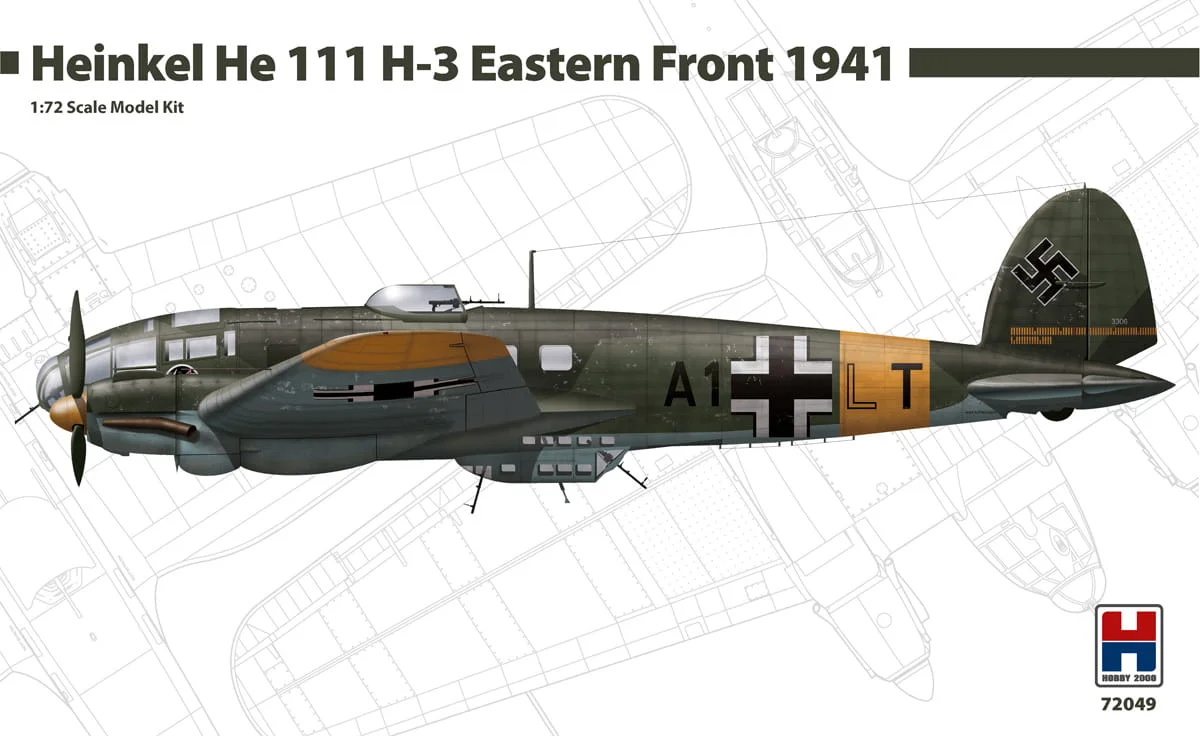



Hobby 2000 72049 - 1:72 Heinkel He-111 H-3 Eastern Front 1941
Do darmowej dostawy brakuje Ci jedynie 299 zł
Masz darmową dostawę ✓
Product code: H2K-72049
Barcode: 5903002057490
Ask about the product

Administratorem danych osobowych jest Sklep Modelarski Exito. Przetwarzamy je w celu przesłania odpowiedzi na zapytanie. Więcej informacji dotyczących przetwarzania danych osobowych znajduje się w polityce prywatności.
Share the product card



Leave feedback on the product

Description
1:72 scale plastic model kit of the German Heinkel He 111 H-3 Eastern Front 1941 bomber
Hobby 2000 72049 represents the Heinkel He 111 H-3 — one of the most numerous versions of the German medium bomber, used intensively after the start of the war against the Soviet Union. The release is devoted to Eastern Front machines of the winter of 1941/42, when He 111s flew both bombing and transport missions in extremely harsh weather.
The kit is based on 1:72 Hasegawa plastic with recessed panel lines and a well-rendered fuselage and elliptical wings. Hobby 2000 has added its own illustrated assembly manual and a new sheet of waterslide decals printed by Cartograf.
The decal sheet covers two marking options: He 111 H-3, W.Nr. 3306, code A1+LT of 9./KG 53 on the Eastern Front in the winter of 1941/42, and aircraft number 10 of the Romanian Grupul 5 Bombardament from the same period — an interesting example of an allied operator of the He 111.
What's in the box:
- Plastic sprues (Hasegawa)
- Clear parts for the glazed nose, cockpit and gun positions
- Sheet of waterslide decals printed by Cartograf for 2 marking options
- Illustrated assembly manual
Model specifications:
- Scale: 1:72
- Catalogue number: 72049
- Manufacturer: Hobby 2000
- Assembled length: approx. 228 mm
- Assembled wingspan: approx. 314 mm
- Skill level: intermediate/advanced
Note: The kit does not include glue, paints or modelling tools. This model is intended for self-assembly.
Assembly:
This is a large twin-engine bomber, so it pays to plan the work in stages. The cockpit and glazed nose interior remain clearly visible on the finished model, so painting and finishing them carefully before closing the fuselage is worthwhile. Aligning the wings and engine nacelles also deserves attention — calm dry-fitting before cementing pays off in an even, true silhouette. The heavily framed glazing calls for good masking tape and patience; the frames are best painted in several thin coats.
For painting you will need the standard Luftwaffe colours: RLM 70 Schwarzgrun and RLM 71 Dunkelgrun on the upper surfaces with RLM 65 Hellblau below, on the winter option covered with temporary white camouflage. The washable white finish used on the Eastern Front wore off quickly, so weathering and chipping effects look very natural on the model. Applying the decals over a gloss coat is recommended, as it limits decal silvering, with a satin varnish for the final finish.
Tools you will need:
- Modelling nippers for removing parts from the sprues
- Hobby knife or scalpel
- Files and sanding paper for cleaning up sprue gate marks
- Plastic cement (e.g. Tamiya Extra Thin Cement)
- Precision modelling tweezers
- Brushes in various sizes or an airbrush
- Model paints (acrylic or enamel)
- Gloss varnish under the decals and satin varnish for the final finish
- Wash for emphasising panel lines and details
About the aircraft – Heinkel He 111:
The Heinkel He 111 was created in the mid-1930s with a dual purpose: officially a fast airliner for Lufthansa, in reality a bomber for the secretly rebuilt Luftwaffe. The design by brothers Siegfried and Walter Gunther stood out for its elliptical wing planform and very clean aerodynamic shape, which at the time made it as fast as contemporary fighters.
It saw its combat debut in Spain with the Condor Legion. From 1939 the He 111 formed the backbone of the German bomber force — it took part in the Polish, Norwegian and French campaigns, and then in the Battle of Britain. That was when the design's limitations became apparent: relatively weak defensive armament of hand-held MG 15 machine guns and a modest bomb load meant heavy losses whenever fighter cover was absent.
The H series, introduced in 1939, became the most numerous variant. It received Junkers Jumo 211 engines and the fully glazed, asymmetric nose with its distinctive offset pilot's canopy. The He 111 remained in production until 1944 and served throughout the war as a transport, glider tug, torpedo bomber and V-1 launch platform. Licence-built CASA 2.111 aircraft were still flying in Spain in the 1960s.
Original aircraft specifications (Heinkel He 111 H-3):
- Crew: 5
- Length: 16.40 m
- Wingspan: 22.60 m
- Height: 4.00 m
- Empty weight: approx. 8,680 kg
- Maximum take-off weight: approx. 14,000 kg
- Powerplant: 2 x Junkers Jumo 211D-1 inline engines, approx. 1,200 hp each
- Maximum speed: approx. 440 km/h
- Service ceiling: approx. 6,500 m
- Range: approx. 2,300 km
- Defensive armament: 20 mm MG FF cannon in the nose and 7.92 mm MG 15 machine guns in flexible positions
- Bomb load: up to approx. 2,000 kg
- Production: 1935-1944, approx. 6,500 built in all versions
About the manufacturer – Hobby 2000:
Hobby 2000 is a Polish model company based in Katowice, known for releasing themed re-editions of existing kits. Rather than tooling its own moulds, Hobby 2000 sources sprues from established manufacturers and builds a complete package around them: its own box, an illustrated assembly manual, a fresh sheet of waterslide decals printed by the Italian printing house Cartograf. This kit is based on Hasegawa plastic. The brand is recognisable above all for its choice of subjects: releases focus on specific squadrons, campaigns and service periods, with a strong presence of Polish themes that rarely appear in the ranges of the large manufacturers. Kits are produced in limited runs, so older releases tend to disappear from the market quickly. For the modeller this means proven plastic combined with fresh, carefully prepared markings and extras that were not part of the original release.
Safety warnings
Certificates and safety warnings
- Product not for children under 14 years of age. Use under adult supervision.
- Contains small parts that may present a choking hazard.
- Contains sharp-edged elements.
- Keep out of reach of pets.
Manufacturer
Hobby 2000 Sp. z o.o.
ul. Tadeusza Kościuszki 227
www.hobby2000.pl
40-600 Katowice, Poland
Other products in this category
-
€30.57Lowest price: €34.74-12%
-
€12.55Lowest price: €14.26-12%
-
€12.34Lowest price: €14.02-12%
-
€14.02
-
€26.17
-
€20.51Lowest price: €23.31-12%
-
€29.73Lowest price: €33.79-12%
-
€31.64
-
€24.07Lowest price: €27.36-12%
-
€31.64
-
€12.13Lowest price: €13.79-12%
-
€31.20Lowest price: €35.45-12%
-
€15.69Lowest price: €17.83-12%
-
€39.79Lowest price: €45.21-12%
-
€18.84Lowest price: €21.40-12%
-
€26.17


Special offers
Check out all the deals
-
€32.04Regular price: €36.40-12%Lowest price: €36.40-12%
-
€18.00Regular price: €20.45-12%Lowest price: €20.45-12%
-
€6.89Regular price: €7.83-12%Lowest price: €6.89-0%
-
€21.77Regular price: €24.74-12%Lowest price: €24.74-12%
-
€31.83Regular price: €36.17-12%Lowest price: €36.17-12%
-
€78.76Regular price: €89.50-12%Lowest price: €89.50-12%
-
€53.20Regular price: €60.45-12%Lowest price: €60.45-12%
-
€31.41Regular price: €35.69-12%Lowest price: €35.69-12%
-
€29.73Regular price: €33.79-12%Lowest price: €33.79-12%
-
€33.92Regular price: €38.55-12%Lowest price: €38.55-12%
-
€20.72Regular price: €23.55-12%Lowest price: €23.55-12%
-
€44.61Regular price: €50.69-12%Lowest price: €50.69-12%
-
€47.96Regular price: €54.50-12%Lowest price: €51.88-8%
-
€18.84Regular price: €21.40-12%Lowest price: €21.40-12%
-
€36.44Regular price: €41.40-12%Lowest price: €41.40-12%
-
€28.68Regular price: €32.60-12%Lowest price: €32.60-12%


Bestsellers
-
€202.36Regular price: €238.07-15%Lowest price: €178.55--13%
-
€161.88
-
€66.64
-
€178.55
-
€214.26
-
€249.98
-
€107.12
-
€95.21
-
€166.64
-
€190.45
-
€166.64
-
€321.40
-
€285.69
-
€492.83
-
€214.26
-
€559.50


 Log in with Google

