





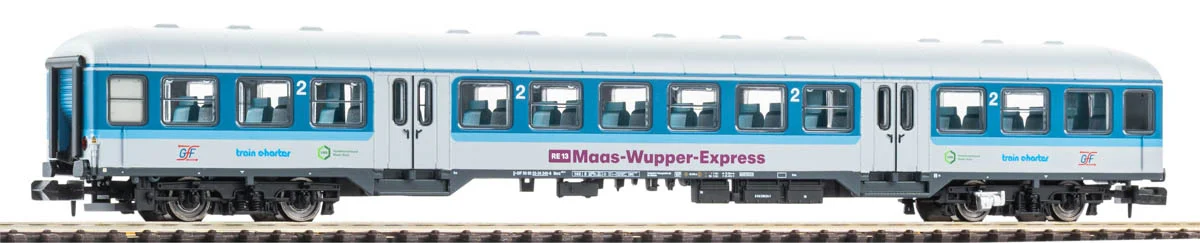
Piko 40654 N - Maas-Wupper-Express GFF 2nd-Class Passenger Car, Era VI
Do darmowej dostawy brakuje Ci jedynie 299 zł
Masz darmową dostawę ✓
Product code: PIKO-40654
Barcode: 4015615406549
Ask about the product

Administratorem danych osobowych jest Sklep Modelarski Exito. Przetwarzamy je w celu przesłania odpowiedzi na zapytanie. Więcej informacji dotyczących przetwarzania danych osobowych znajduje się w polityce prywatności.
Share the product card



Leave feedback on the product

Description
Model of a 2nd class regional passenger car in Maas-Wupper-Express livery of Gesellschaft für Fahrzeugtechnik
A stainless steel body, generous windows and a plain, functional outline — the German regional cars known as Silberlinge are among the most recognisable passenger vehicles of post-war Europe. This model shows a 2nd class example in the livery of the Maas-Wupper-Express operated by the private company Gesellschaft für Fahrzeugtechnik, set in era VI. It is made in N scale and measures 165 mm over buffers.
As on the prototype, window layout and interior fittings follow the class of the car — in the 2nd class version the windows run in an even rhythm along the whole body. Precisely implemented dimensions give proportions true to the original, while plastic bogies produced from carefully worked moulds complete the underframe. Painting and printing are cleanly done, with legible operator markings and numbering. The car is prepared for interior lighting, for which the manufacturer specifies kit no. 46293. The coupling sits in an NEM 362 pocket with a close coupling mechanism, keeping vehicle spacing tight and the connection secure. Running characteristics are smooth and quiet.
Model specifications:
- Scale: N (1:160)
- Item number: 40654
- Manufacturer: PIKO
- Length over buffers: 165 mm
- Railway administration: private operator — Gesellschaft für Fahrzeugtechnik (GfF), era VI
- Vehicle type: regional passenger car, 2nd class
- Intended for direct current (DC) model track
- Coupling: NEM 362 pocket with close coupling mechanism
- Minimum radius: 192 mm
- Interior lighting: prepared for retrofitting, kit no. 46293 available separately
- Plastic bogies from high-quality moulds
- Ready to run, factory painted and assembled
- Age recommendation: 14 years and up
Please note: this car has no drive of its own.
It is an unpowered trailer intended for locomotive-hauled consists, so it does not move by itself and needs no decoder. To run it you need a powered track, a controller and a locomotive. The minimum radius is 192 mm, worth allowing for when planning curves on a layout. The car combines readily into longer rakes with the other vehicles of this family, including the control car in the same livery.
About the regional passenger car:
These cars were the answer to the post-war growth of suburban traffic in West Germany. Prototypes were built from 1958 and series production ran from 1959 to 1980, yielding around five thousand vehicles. The 1957 order was shared between four builders: WMD at Donauwörth, Wegmann & Co. at Kassel, LHB at Salzgitter and MaK at Kiel.
The first batches carried unpainted stainless steel bodies with a pearl-like sheen, which is exactly where the Silberling nickname came from. A body 26,400 mm long over buffers, 2,825 mm wide and 4,050 mm high seated 96 passengers in the 2nd class version. Tare weight ranged from 31 to 40 tonnes depending on variant. Earlier cars ran at 120 km/h, later disc-braked ones at 140 km/h. The family included 2nd class cars, composite 1st/2nd class cars, cars with a luggage compartment and control cars.
For decades they were the most common vehicle in German regional traffic, hauled by electric and diesel locomotives alike. From 1986 part of the fleet was repainted in mint turquoise, and after 1996 traffic red became the dominant livery. Deutsche Bahn withdrew the last of them on 16 October 2022, after more than sixty years of service — but they did not vanish from the rails: private operators took them over, among them Gesellschaft für Fahrzeugtechnik of Crailsheim, which supplies classic locomotive-hauled rakes for replacement and reinforcement duties. It is in that role that these cars reached the Maas-Wupper-Express, running from Venlo in the Netherlands to Hamm in Westphalia.
Prototype specifications (regional passenger car, the Silberling):
- Builders: WMD Donauwörth, Wegmann & Co. Kassel, LHB Salzgitter, MaK Kiel
- Build years: prototypes from 1958, series production 1959–1980, around 5,000 vehicles
- Length over buffers: 26,400 mm
- Width: 2,825 mm, height: 4,050 mm
- Tare weight: 31–40 t depending on variant
- Maximum speed: 120 km/h, disc-braked versions 140 km/h
- Seating: 96 in the 2nd class car
- Four-axle car on two bogies, unpowered
- Purpose: regional and suburban services
About the manufacturer – PIKO:
The PIKO story begins in 1949 in Sonneberg, Thuringia, and has continued without a break ever since, giving the company more than seventy years of model railway experience. Today it is one of the most popular modelling brands in Europe, found on beginners' layouts and in the collections of experienced modellers alike. The catalogue spans scales H0, TT, N and G, with stock from era I through to present-day vehicles. The PIKO Expert line combines high-quality detailing with modern digital technology. The company is also a leading producer of Polish prototype models — PKP, PKP Intercity and PKP Cargo vehicles.
Safety warnings
Certificates and safety warnings
- This product is a collector's item intended for users aged 14 and above, and is not a toy for children.
- Before use, read the user manual, use the product as intended and follow the safety instructions contained in the manual and on the packaging.
- May contain small parts that pose a choking/swallowing hazard.
- Use indoors. Protect from moisture and water, which may damage electrical or mechanical components.
- Use the product only when it is in perfect condition.
- Do not use a damaged power cord or power supply. If the cord or power supply shows signs of damage, replace it immediately with original accessories recommended by the manufacturer.
- The product may only be used by children under adult supervision.
- Use only with recommended accessories and additional components.
- Ensure good ventilation: do not block ventilation openings, do not cover devices and do not use in closed, heated spaces.
- Do not expose to prolonged sunlight.
- Before connecting to the power supply, check that the voltage in the socket meets the requirements specified in the manual.
- Do not touch the rails when the control panel is live.
- Do not place metal objects on the rails; this may cause a short circuit and damage the system.
- Disconnect the power supply from the mains after use.
- Do not disassemble the device. Disassembling the controller, control panel or power supply yourself may damage the equipment, void the warranty and cause electric shock.
- If the product has stopped functioning properly, contact customer service/support.
Manufacturer
PIKO Spielwaren GmbH
Lutherstraße 30
96515 Sonneberg, Germany
Other products in this category
-
€54.74
-
€140.45
-
€59.50
-
€85.69


Special offers
Check out all the deals
-
€13.18Regular price: €14.98-12%Lowest price: €14.98-12%
-
€5.01Regular price: €5.69-12%Lowest price: €5.69-12%
-
€4.59Regular price: €5.21-12%Lowest price: €5.21-12%
-
€14.65Regular price: €16.64-12%Lowest price: €16.64-12%
-
€37.69Regular price: €42.83-12%Lowest price: €37.69-0%
-
€2.49Regular price: €2.83-12%Lowest price: €2.83-12%
-
€2.49Regular price: €2.83-12%Lowest price: €2.83-12%
-
€2.49Regular price: €2.83-12%Lowest price: €2.83-12%
-
€2.49Regular price: €2.83-12%Lowest price: €2.83-12%
-
€2.49Regular price: €2.83-12%Lowest price: €2.83-12%
-
€2.49Regular price: €2.83-12%Lowest price: €2.83-12%
-
€2.49Regular price: €2.83-12%Lowest price: €2.83-12%
-
€2.49Regular price: €2.83-12%Lowest price: €2.83-12%
-
€2.49Regular price: €2.83-12%Lowest price: €2.83-12%
-
€2.49Regular price: €2.83-12%Lowest price: €2.83-12%
-
€2.49Regular price: €2.83-12%Lowest price: €2.83-12%


Bestsellers
-
€202.36Regular price: €238.07-15%Lowest price: €178.55--13%
-
€161.88
-
€66.64
-
€178.55
-
€214.26
-
€249.98
-
€107.12
-
€95.21
-
€166.64
-
€190.45
-
€166.64
-
€321.40
-
€285.69
-
€492.83
-
€214.26
-
€559.50


 Log in with Google
