





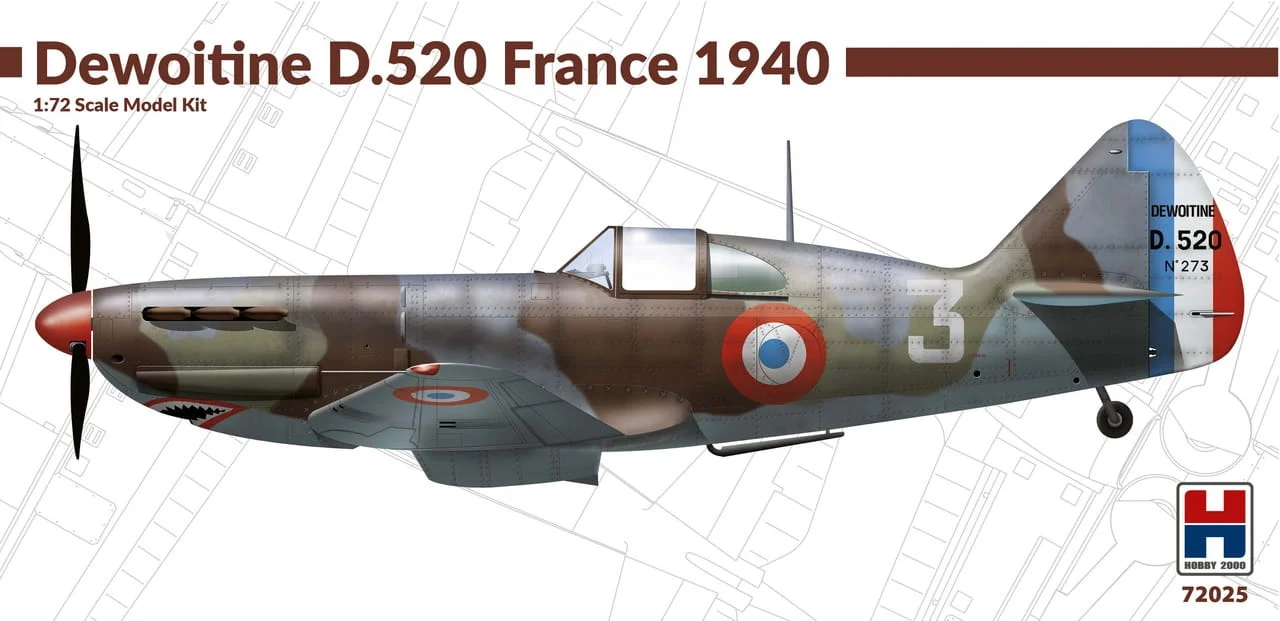
Hobby 2000 72025 - 1:72 Dewoitine D.520 France 1940
Do darmowej dostawy brakuje Ci jedynie 299 zł
Masz darmową dostawę ✓
Product code: H2K-72025
Barcode: 5903002057254
Ask about the product

Administratorem danych osobowych jest Sklep Modelarski Exito. Przetwarzamy je w celu przesłania odpowiedzi na zapytanie. Więcej informacji dotyczących przetwarzania danych osobowych znajduje się w polityce prywatności.
Share the product card



Leave feedback on the product

Description
Plastic model kit of the French Dewoitine D.520 fighter in 1:72 scale
The Dewoitine D.520 was the best French fighter of the 1940 campaign – the only aircraft in the Armée de l'Air able to meet the Messerschmitt Bf 109 E on equal terms. Armed with a cannon firing through the propeller hub and four machine guns in the wings, agile and structurally strong, it reached the units too late and in too small numbers to change the outcome of the campaign.
Hobby 2000 72025 is based on Hasegawa sprues, complemented by a new sheet of waterslide decals printed by Cartograf and self-adhesive masks for the glazing. The first marking option carries particular significance: D.520 no. 119/M of Col Mieczyslaw Mumler of GC II/7, one of the most experienced Polish fighter leaders, who continued the fight in France after the September Campaign of 1939.
The other two schemes are aircraft flown by French pilots in May and June 1940: D.520 no. 273/3 of A/C Denis Ponteins of the 4th escadrille, GC II/7 at Avelanges, and D.520 no. 90/2 of Sous-Lt Michel Madon of the 1st escadrille, GC I/3 at Meaux-Esbly.
What you will find in the box:
- Plastic sprues with airframe, cockpit and undercarriage parts
- Clear parts for the canopy glazing
- Self-adhesive masks for the glazing
- Waterslide decal sheet printed by Cartograf covering three marking options
- Illustrated assembly instructions
Model specifications:
- Scale: 1:72
- Catalogue number: 72025
- Manufacturer: Hobby 2000
- Length of the finished model: approx. 119 mm
- Wingspan of the finished model: approx. 142 mm
- Skill level: beginner/intermediate
Please note: the kit does not include glue, paints or modelling tools. The model is intended for self-assembly.
Building the model:
The kit is small and built from a sensible number of parts, which makes it a good candidate for one of the first fighters in a collection. The cockpit with its seat and instrument panel is best painted before the fuselage halves are joined. The included self-adhesive masks make painting the canopy framing straightforward, and the compact airframe means the kit can be finished quickly.
French fighters of 1940 wore a three-colour camouflage on the upper surfaces – dark brown, khaki and dark green – over light grey undersides, with characteristically soft transitions between the patches. Such a scheme is best reproduced with an airbrush at low pressure; if brush painting, it is worth building the colours up in several thin coats. Applying the decals over a gloss coat reduces the risk of silvering, and a satin varnish makes a suitable final finish.
Tools you will need:
- Modelling nippers for removing parts from the sprues
- Modelling knife or scalpel
- Files and sanding paper for cleaning up gate marks
- Plastic cement (e.g. Tamiya Extra Thin Cement)
- Precision modelling tweezers
- Brushes in various sizes or an airbrush
- Modelling paints (acrylic or enamel)
- Gloss varnish for the decals and satin varnish for the final finish
- Decal setting solution to help the decals conform to the detail
- Modelling wash to emphasise the detail and panel lines
About the aircraft – Dewoitine D.520:
The Dewoitine D.520 originated in the second half of the 1930s as a private venture by Emile Dewoitine's team, responding to the French air force's need for a modern fighter. The prototype first flew in October 1938. The designers concentrated on clean aerodynamics, a strong airframe and armament built around a 20 mm Hispano-Suiza HS.404 cannon firing through the hollow propeller shaft. The Hispano-Suiza 12Y engine of some 935 hp was less powerful than those of its rivals, but the aircraft made up for it with agility and good acceleration in a dive.
Series production started late, and front-line units only began receiving the D.520 at the turn of 1939 and 1940. When the German offensive opened on 10 May 1940, only a few dozen machines were combat ready. Even so, pilots flying the D.520 claimed more than a hundred air victories in six weeks for the loss of fewer than sixty aircraft. After the armistice some airframes remained in Vichy service, others went to the Free French, and a number were taken over by Germany, Italy and Bulgaria.
In Polish aviation history the D.520 is remembered thanks to the pilots who made their way to France after the September Campaign of 1939 and joined French fighter units. One of them was Col Mieczyslaw Mumler – an experienced fighter leader who commanded the Polish flight operating within GC II/7 and flew the D.520 in combat in June 1940. After the fall of France, Polish airmen such as Mumler reached Britain, where they formed the command cadre of the Polish squadrons in the RAF. The Hobby 2000 kit allows his aircraft, no. 119/M from the airfield at Ouanne, to be recreated.
Original aircraft specifications (Dewoitine D.520):
- Length: 8.60 m
- Wingspan: 10.20 m
- Height: 2.57 m
- Empty weight: approx. 2,040 kg
- Maximum take-off weight: approx. 2,790 kg
- Crew: 1
- Powerplant: Hispano-Suiza 12Y-45 inline engine of approx. 935 hp
- Maximum speed: approx. 560 km/h
- Service ceiling: approx. 10,000 m
- Range: approx. 1,250 km
- Armament: one 20 mm Hispano-Suiza HS.404 cannon firing through the propeller hub and four 7.5 mm MAC 1934 machine guns in the wings
- Production: approx. 900 aircraft
About the manufacturer – Hobby 2000:
Hobby 2000 is a Polish model company based in Katowice that builds its range around its own themed releases of plastic kits. Each box contains sprues from an established manufacturer – in this case Hasegawa sprues – combined with the company's own artwork, illustrated assembly instructions and a new decal sheet. The waterslide decals for the brand's kits are printed by Cartograf of Italy, valued in the industry for their thin carrier film and accurate colour registration. Most of the aircraft releases also include self-adhesive masks for the glazing, which makes painting the canopy frames considerably easier. Hobby 2000 selects its subjects around specific campaigns, units and pilots, and Polish themes appear regularly in the catalogue. Print runs are limited, so once a release sells out it rarely returns. For the modeller this means access to proven tooling in a boxing with carefully researched markings that are often hard to find elsewhere.
Safety warnings
Certificates and safety warnings
- Product not for children under 14 years of age. Use under adult supervision.
- Contains small parts that may present a choking hazard.
- Contains sharp-edged elements.
- Keep out of reach of pets.
Manufacturer
Hobby 2000 Sp. z o.o.
ul. Tadeusza Kościuszki 227
www.hobby2000.pl
40-600 Katowice, Poland
Other products in this category
-
€38.95Lowest price: €26.56--47%
-
€31.20Lowest price: €35.45-12%
-
€30.57Lowest price: €34.74-12%
-
€39.79Lowest price: €45.21-12%
-
€24.07Lowest price: €27.36-12%
-
€14.02
-
€15.69Lowest price: €17.83-12%
-
€12.55Lowest price: €14.26-12%
-
€31.64
-
€26.17
-
€31.64
-
€26.17
-
€20.51Lowest price: €23.31-12%
-
€29.73Lowest price: €33.79-12%
-
€20.09Lowest price: €22.83-12%
-
€12.34Lowest price: €14.02-12%


Special offers
Check out all the deals
-
€16.53Regular price: €18.79-12%Lowest price: €14.98--10%
-
€20.09Regular price: €22.83-12%Lowest price: €22.83-12%
-
€4.38Regular price: €4.98-12%Lowest price: €4.98-12%
-
€8.78Regular price: €9.98-12%Lowest price: €9.98-12%
-
€7.52Regular price: €8.55-12%Lowest price: €8.55-12%
-
€9.83Regular price: €11.17-12%Lowest price: €11.17-12%
-
€6.89Regular price: €7.83-12%Lowest price: €7.83-12%
-
€14.65Regular price: €16.64-12%Lowest price: €16.64-12%
-
€3.33Regular price: €3.79-12%Lowest price: €3.79-12%
-
€3.54Regular price: €4.02-12%Lowest price: €4.02-12%
-
€5.01Regular price: €5.69-12%Lowest price: €5.69-12%
-
€20.30Regular price: €23.07-12%Lowest price: €23.07-12%
-
€14.65Regular price: €16.64-12%Lowest price: €13.31--10%
-
€14.65Regular price: €16.64-12%Lowest price: €16.64-12%
-
€10.87Regular price: €12.36-12%Lowest price: €12.36-12%
-
€2.49Regular price: €2.83-12%Lowest price: €2.83-12%


Bestsellers
-
€202.36Regular price: €238.07-15%Lowest price: €178.55--13%
-
€161.88
-
€66.64
-
€178.55
-
€214.26
-
€249.98
-
€107.12
-
€95.21
-
€166.64
-
€190.45
-
€166.64
-
€321.40
-
€285.69
-
€492.83
-
€214.26
-
€559.50


 Log in with Google
