





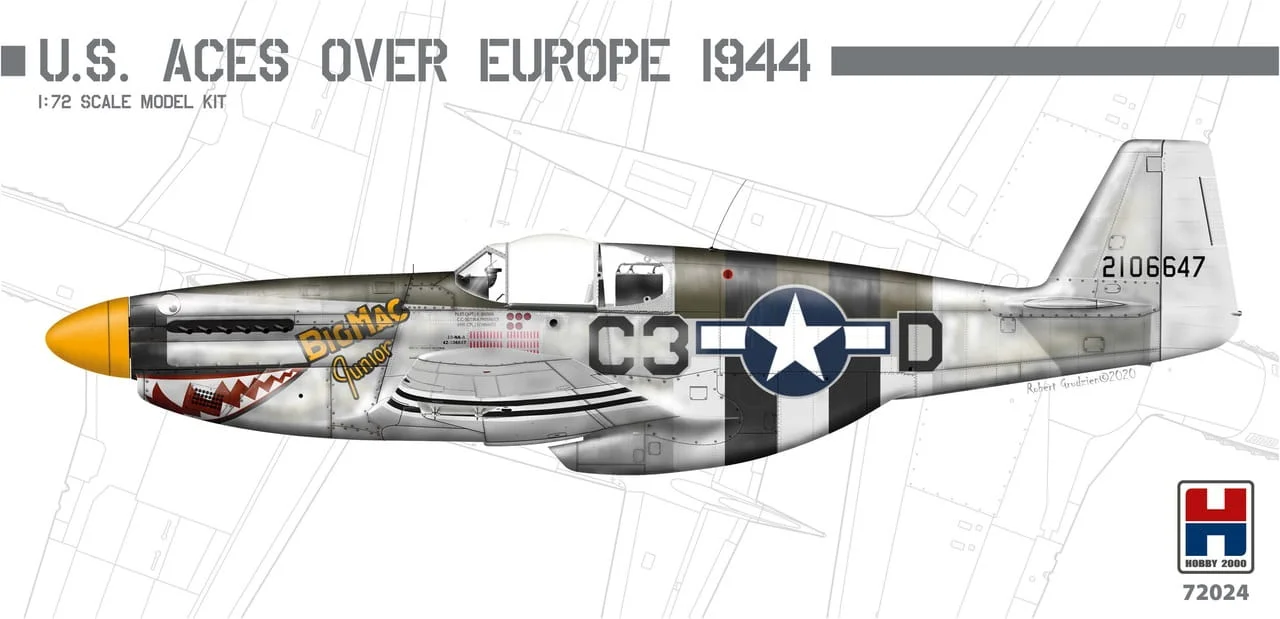
Hobby 2000 72024 - 1:72 P-51B Mustang US Aces over Europe 1944
Do darmowej dostawy brakuje Ci jedynie 299 zł
Masz darmową dostawę ✓
Product code: H2K-72024
Barcode: 5903002057247
Ask about the product

Administratorem danych osobowych jest Sklep Modelarski Exito. Przetwarzamy je w celu przesłania odpowiedzi na zapytanie. Więcej informacji dotyczących przetwarzania danych osobowych znajduje się w polityce prywatności.
Share the product card



Leave feedback on the product

Description
Plastic model kit of the American North American P-51B Mustang fighter in 1:72 scale
The P-51B was the version in which the Mustang became the fighter that changed the course of the air war over Europe. Replacing the American Allison engine with the licence-built Packard V-1650 – the counterpart of the British Rolls-Royce Merlin – gave the aircraft excellent high-altitude performance, while its large internal fuel capacity and underwing drop tanks allowed it to escort bombers all the way to Berlin.
Hobby 2000 72024 is based on Hasegawa sprues, complemented by a new sheet of waterslide decals printed by Cartograf and self-adhesive masks for the glazing. The release is devoted to American aces of 1944 – the decals cover three specific aircraft, including the famous "Berlin Express" flown by Lt William B. Overstreet of the 363rd FS / 357th FG.
What you will find in the box:
- Plastic sprues with airframe, cockpit and undercarriage parts
- Clear parts for the canopy glazing
- Underwing drop tanks for extended range
- Self-adhesive masks for the glazing
- Waterslide decal sheet printed by Cartograf covering three marking options
- Illustrated assembly instructions
Model specifications:
- Scale: 1:72
- Catalogue number: 72024
- Manufacturer: Hobby 2000
- Length of the finished model: approx. 137 mm
- Wingspan of the finished model: approx. 157 mm
- Skill level: beginner/intermediate
Please note: the kit does not include glue, paints or modelling tools. The model is intended for self-assembly.
Building the model:
This is a small, conventionally engineered kit with a sensible parts count that less experienced modellers will handle comfortably. It is worth painting and finishing the cockpit before the fuselage halves are joined, as access becomes very limited afterwards. The multi-panel canopy typical of early Mustangs needs careful alignment, and the included self-adhesive masks make painting its framing much easier.
All three aircraft wear the finishes typical of American escort fighters in 1944 – Olive Drab or natural metal with the colourful group recognition markings. On bare metal surfaces it is worth considering airbrushed metallic paints with subtle shade variation between individual panels. Applying the decals over a gloss coat reduces the risk of silvering, and a satin varnish makes a suitable final finish. To raise the level of detail you may wish to consider a turned metal pitot tube or a seat belt set, available separately in our shop.
Tools you will need:
- Modelling nippers for removing parts from the sprues
- Modelling knife or scalpel
- Files and sanding paper for cleaning up gate marks
- Plastic cement (e.g. Tamiya Extra Thin Cement)
- Precision modelling tweezers
- Brushes in various sizes or an airbrush
- Modelling paints (acrylic or enamel)
- Gloss varnish for the decals and satin varnish for the final finish
- Decal setting solution to help the decals conform to the detail
- Modelling wash to emphasise the detail and panel lines
About the aircraft – North American P-51B Mustang:
The Mustang came into being remarkably quickly – North American Aviation designed it in 1940 to a British purchasing commission requirement, and the prototype flew only a few months after the contract was signed. The aircraft featured an advanced laminar-flow wing section and exceptionally refined aerodynamics, including the distinctive radiator duct under the rear fuselage. The early Allison-engined versions performed well at low level but lost their edge at the altitudes where the war over Germany was being fought.
The breakthrough came with the British Rolls-Royce Merlin, built under licence in the United States by Packard as the V-1650. The result was the P-51B, produced at Inglewood, and the identical P-51C from the Dallas plant. The aircraft gained over 100 km/h at altitude along with a ceiling that allowed it to fight German fighters on their own terms. Combined with underwing drop tanks, this gave the American air forces something they had lacked: an escort fighter able to accompany the bombers all the way to the target and back.
In the spring of 1944 the Mustangs of the Eighth Air Force took air superiority over the Reich away from the Luftwaffe – one of the preconditions for the success of the Normandy landings. The P-51B still had the original framed canopy and the fuselage spine behind the cockpit, which restricted the view to the rear; some aircraft received the bulged Malcolm Hood in the field, while the definitive solution arrived with the bubble canopy of the P-51D. Several of the most successful American aces of the European theatre flew the P-51B, among them George Preddy and William Overstreet.
Original aircraft specifications (North American P-51B Mustang):
- Length: 9.83 m
- Wingspan: 11.28 m
- Height: 4.17 m
- Empty weight: approx. 3,100 kg
- Maximum take-off weight: approx. 5,080 kg
- Crew: 1
- Powerplant: Packard V-1650-3 inline engine (licence-built Rolls-Royce Merlin) of approx. 1,380 hp
- Maximum speed: approx. 700 km/h
- Service ceiling: approx. 12,700 m
- Range: approx. 1,300 km, approx. 2,400 km with drop tanks
- Armament: 4 x 12.7 mm Browning M2 machine guns in the wings; underwing racks for bombs or fuel tanks
- Production: approx. 1,990 P-51B (Inglewood) and approx. 1,750 identical P-51C (Dallas)
About the manufacturer – Hobby 2000:
Hobby 2000 is a Polish model company based in Katowice that builds its range around its own themed releases of plastic kits. Each box contains sprues from an established manufacturer – in this case Hasegawa sprues – combined with the company's own artwork, illustrated assembly instructions and a new decal sheet. The waterslide decals for the brand's kits are printed by Cartograf of Italy, valued in the industry for their thin carrier film and accurate colour registration. Most of the aircraft releases also include self-adhesive masks for the glazing, which makes painting the canopy frames considerably easier. Hobby 2000 selects its subjects around specific campaigns, units and pilots, and Polish themes appear regularly in the catalogue. Print runs are limited, so once a release sells out it rarely returns. For the modeller this means access to proven tooling in a boxing with carefully researched markings that are often hard to find elsewhere.
Safety warnings
Certificates and safety warnings
- Product not for children under 14 years of age. Use under adult supervision.
- Contains small parts that may present a choking hazard.
- Contains sharp-edged elements.
- Keep out of reach of pets.
Manufacturer
Hobby 2000 Sp. z o.o.
ul. Tadeusza Kościuszki 227
www.hobby2000.pl
40-600 Katowice, Poland
Other products in this category
-
€27.36
-
€37.69Lowest price: €42.83-12%
-
€27.22Lowest price: €30.93-12%
-
€23.03Lowest price: €26.17-12%
-
€16.53Lowest price: €18.79-12%
-
€14.85Lowest price: €16.88-12%
-
€19.02
-
€22.83
-
€17.16Lowest price: €19.50-12%
-
€9.74
-
€18.79
-
€15.21
-
€18.79
-
€19.02
-
€18.84Lowest price: €21.40-12%
-
€23.03Lowest price: €26.17-12%


Special offers
Check out all the deals
-
€32.04Regular price: €36.40-12%Lowest price: €36.40-12%
-
€18.00Regular price: €20.45-12%Lowest price: €20.45-12%
-
€6.89Regular price: €7.83-12%Lowest price: €6.89-0%
-
€21.77Regular price: €24.74-12%Lowest price: €24.74-12%
-
€31.83Regular price: €36.17-12%Lowest price: €36.17-12%
-
€78.76Regular price: €89.50-12%Lowest price: €89.50-12%
-
€53.20Regular price: €60.45-12%Lowest price: €60.45-12%
-
€31.41Regular price: €35.69-12%Lowest price: €35.69-12%
-
€29.73Regular price: €33.79-12%Lowest price: €33.79-12%
-
€33.92Regular price: €38.55-12%Lowest price: €38.55-12%
-
€20.72Regular price: €23.55-12%Lowest price: €23.55-12%
-
€44.61Regular price: €50.69-12%Lowest price: €50.69-12%
-
€47.96Regular price: €54.50-12%Lowest price: €51.88-8%
-
€18.84Regular price: €21.40-12%Lowest price: €21.40-12%
-
€36.44Regular price: €41.40-12%Lowest price: €41.40-12%
-
€28.68Regular price: €32.60-12%Lowest price: €32.60-12%


Bestsellers
-
€202.36Regular price: €238.07-15%Lowest price: €178.55--13%
-
€161.88
-
€66.64
-
€178.55
-
€214.26
-
€249.98
-
€107.12
-
€95.21
-
€166.64
-
€190.45
-
€166.64
-
€321.40
-
€285.69
-
€492.83
-
€214.26
-
€559.50


 Log in with Google
